
The Forensic Economics of Unplanned Downtime in Continuous Process Plants
A quantitative financial investigation into flaring penalties, thermal shock degradation, catalyst deactivation, and the true $240,000/hour cost of machine failure.
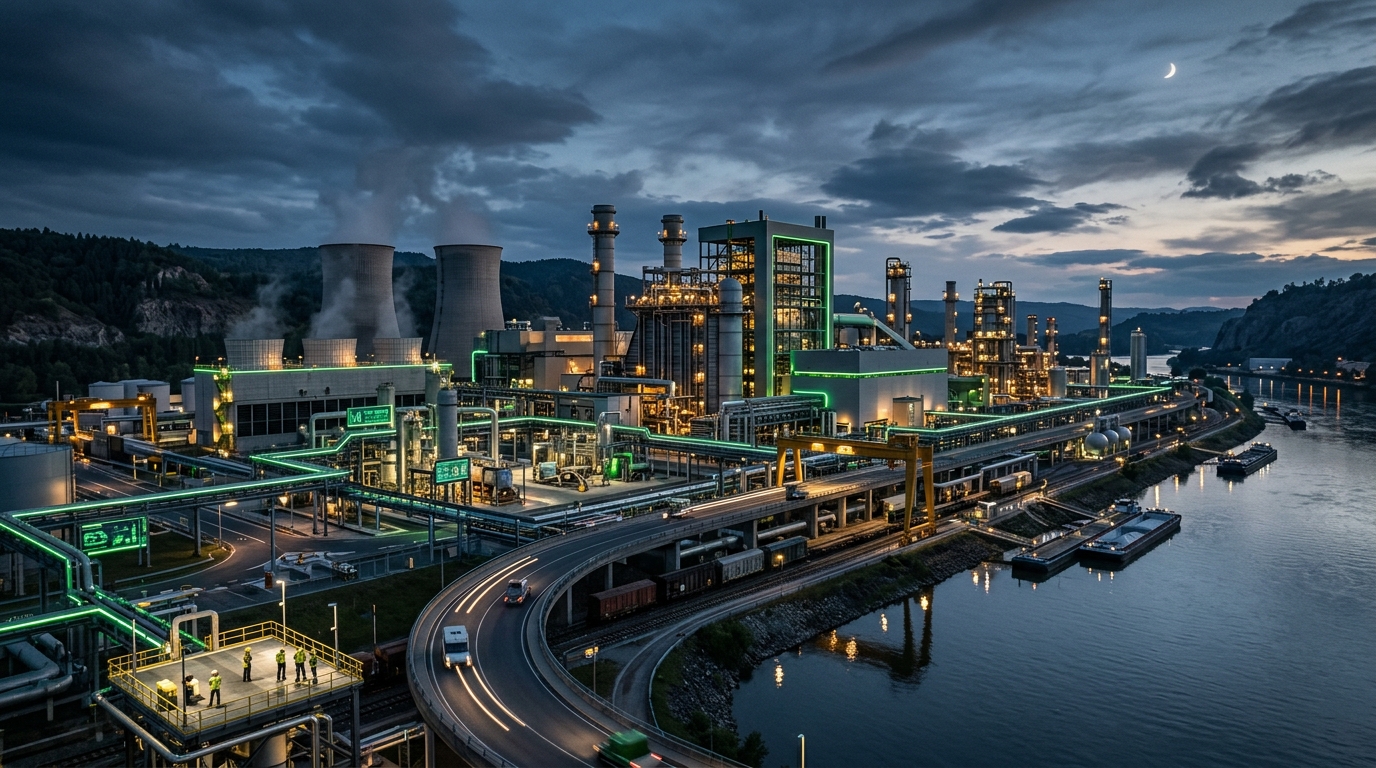
Corporate accounting departments routinely calculate the cost of unplanned machine outages as direct labor and replacement spare parts, underestimating operational losses by over eight hundred percent. Forensic financial analysis of continuous petrochemical trains reveals the cascading thermodynamic costs of unscheduled trips.
JUBAIL — At two-fifteen on a Tuesday afternoon inside the central control building of a world-scale ethylene cracker along the Gulf coast, an alarm siren sounds as the primary cracked-gas compressor trips on a high-radial-vibration interlock. Outside, across the vast maze of cracking furnaces and distillation columns, the silence of a tripped plant is immediately shattered by the deafening, jet-engine roar of high-pressure safety relief valves opening. At the top of the facility's 120-meter emergency flare stacks, massive plumes of luminous orange flame erupt into the sky, combusting hundreds of tons of high-purity hydrocarbon feedstock per hour to prevent catastrophic over-pressurization of the process vessels. In the executive suite, an automated accounting notification estimates the preliminary cost of the incident: forty-five thousand dollars, representing the purchase price of replacement hydrodynamic journal bearings and eight technician overtime hours.
This traditional accounting figure represents a catastrophic financial distortion. In capital-intensive continuous manufacturing operations, calculating the cost of unplanned downtime as the direct price of replacement mechanical components and maintenance labor is akin to measuring the destruction of a shipwreck by the cost of replacement lifebuoys.
When industrial forensic economists audit the true systemic financial toll of an unscheduled plant trip across continuous refining, petrochemical, and power generation facilities, the verified financial loss does not measure forty-five thousand dollars. It exceeds 4.8 million dollars for a single twenty-hour outage: an unyielding operational burn rate of two hundred and forty thousand dollars for every single hour the machinery train stands idle.
The staggering disparity between corporate ledger maintenance costs and real economic loss lies in the multi-tiered financial cascade triggered when a continuous thermodynamic process is violently interrupted.
The first and most visible tier is Lost Opportunity Gross Margin. An ethylene cracker operating at nameplate capacity processes hundreds of tons of ethane and propane feedstock per hour, yielding high-value chemical building blocks: polymer-grade ethylene, propylene, and butadiene. When the cracked gas compressor trips, the entire chemical train halts instantly. At prevailing market crack spreads, the unrecoverable gross production margin lost across a twenty-hour outage directly drains between 1.8 and 2.6 million dollars from the enterprise balance sheet.
The second tier is Flare Hydrocarbon Loss and Environmental Penalties. During an emergency trip, cracking furnaces cannot instantly extinguish their thermal inertia. To protect structural vessel metallurgy from over-pressurization, valuable raw hydrocarbons must be routed to emergency flare headers. In a single major trip event, between eight hundred and fifteen hundred tons of processed gas are incinerated. Compounding the raw feedstock write-off are punitive regulatory non-compliance fines levied by environmental authorities for sulfur dioxide, volatile organic compounds, and greenhouse gas emissions exceeding statutory flaring limits.
The third tier, and the most insidious, is Thermodynamic Shock and Latent Capital Asset Degradation. A petrochemical process operating at high temperatures and pressures exists in delicate thermodynamic equilibrium. When an emergency trip occurs, hot reactor beds, high-pressure steam headers, and quench oil towers experience severe, uncontrolled thermal shock. Steam piping contracts violently, triggering flange leaks; refractory linings inside furnace fireboxes crack and spall under rapid cooling; and expensive precious-metal catalyst beds inside selective hydrogenation reactors suffer severe hydrothermal sintering and irreversible pore collapse, destroying millions of dollars in remaining catalyst lifespan.
The fourth tier is the Cascading Recommissioning Penalty. Restarting a massive continuous petrochemical facility is not an instantaneous operation. Before introducing hydrocarbon feed, operators must spend eighteen to thirty-six hours purging equipment with nitrogen, slowly warming steam lines to prevent hydraulic water hammer, and re-establishing chemical fractionation equilibria. During this protracted restart ramp, thousands of tons of intermediate chemical production fail to meet commercial purity specifications, forcing off-spec product to be reprocessed or downgraded to low-value fuel gas at severe financial discounts.
Finally, the fifth tier encompasses Downstream Contractual Penalties and Working Capital Disruptions. In globalized supply chains, industrial operators operate under strict 'Take-or-Pay' delivery contracts with international shipping fleets, maritime parcel tankers, and downstream plastics manufacturers. When an unplanned outage causes a missed shipping loading window at industrial export terminals, facilities incur crippling maritime demurrage penalties running up to eighty thousand dollars per day per chartered vessel, alongside legal default risks and reputational damage.
By calculating the true, comprehensive economic loss function of unforced asset outages, progressive industrial enterprises fundamentally re-evaluate the return on investment of advanced reliability technologies. Investing in 102.4 kHz continuous edge telemetry, autonomous vibration diagnostic agents, and stochastic storeroom optimization is no longer viewed as an optional operational expense; it is recognized as vital corporate balance sheet insurance. In the merciless financial reality of high-consequence continuous manufacturing, preventing a single unforced trip of a critical turbomachinery train pays for the entire enterprise predictive reliability infrastructure for the next decade.
In the financial accounting systems of heavy continuous manufacturing enterprises, the reported cost of an unscheduled plant outage is almost universally an order of magnitude lower than its true economic damage. Traditional corporate accounting practices classify downtime costs through the narrow lens of direct maintenance expenditure: the cost of emergency replacement parts (such as mechanical seals, impellers, or bearings) combined with the hourly wages and overtime premiums of maintenance craftspeople. Under this myopic financial model, a major twenty-four-hour trip of a primary cracker compressor may appear on quarterly maintenance budget ledger sheets as an innocuous expense of eighty-five thousand dollars. In financial and operational reality, the true total cost of that single outage frequently exceeds six million dollars.
Unraveling the True Cost of Downtime ($TCD$) requires a comprehensive multi-variable economic loss formulation that captures cascading systemic liabilities across the industrial value chain: $TCD = C_{direct} + C_{flare} + C_{offspec} + C_{catalyst} + C_{demurrage} + int_{0}^{MTTR} [Q_{nom}(t) - Q_{actual}(t)] [P_{spot}(t) - C_{var}] , dt$. The largest single component is almost always unrecovered gross margin: in world-scale petrochemical facilities producing thousands of tons of high-value ethylene, propylene, or paraxylene per day, every single hour of lost production destroys between one hundred and fifty thousand and three hundred and fifty thousand dollars of pure contribution margin that can never be recovered.
Beyond immediate production volume losses lies the insidious cost of process thermodynamics and secondary asset damage. In continuous high-temperature chemical reactions, an abrupt unforced trip induces severe thermal contraction across furnace tubes, heat exchangers, and catalytic reactor beds. Rapid thermal cycling causes metallurgical shock, fracturing expensive reforming and hydrocracking catalyst pellets. Heavy catalyst attrition shortens catalyst bed lifespan from an engineered four years down to eighteen months, forcing premature turnaround changeouts costing upwards of four million dollars per reactor. Furthermore, sudden process depressurization forces plant operators to divert hydrocarbon inventories to emergency flare stacks, incurring tens of thousands of dollars in flared feedstocks alongside stringent environmental regulatory penalties.
Supply chain and commercial liabilities escalate the financial damage into the logistics domain. Continuous manufacturing facilities do not operate in isolation; they are tightly bound to international maritime shipping schedules and regional distribution networks. An unscheduled four-day outage on an export-oriented chemical facility leaves Very Large Gas Carriers (VLGC) and chemical product tankers idling at marine loading terminals. International maritime charter contracts impose severe ship demurrage penalties, running between forty-five thousand and eighty-five thousand dollars per vessel per day. If the plant fails to fulfill contractual supply quotas, spot-market replacement purchasing penalties and liquidated damages clauses further compound the commercial catastrophe.
This economic reality was forensically analyzed following an unspared wet gas compressor trip at a major Eastern Province integrated refinery. The initial mechanical failure—a sheared shaft coupling sleeve—required a direct maintenance expenditure of 142,000 dollars in replacement parts and contractor labor. However, the comprehensive forensic accounting investigation revealed a staggering total economic impact of 11.8 million dollars. Flaring losses totaled 620,000 dollars; off-spec product reprocessing consumed 480,000 dollars; downstream delayed coking thermal disruption cost 1.4 million dollars; tanker demurrage penalties reached 340,000 dollars; and unrecovered production margin accounted for 8.8 million dollars. Direct maintenance represented less than 1.2% of the actual financial catastrophe. For industrial executives, understanding the true economics of downtime elevates predictive reliability from an operational maintenance line-item into the paramount driver of corporate profitability and shareholder value.
Listen to our podcast, Read our newsletter
Join 25,000+ plant reliability and asset health engineers receiving our weekly deep dives.
Subscribe to our weekly systems engineering letter.
Select your engineering discipline to receive calibrated benchmarks and failure modes (ISO 14224).
Related articles
Beyond the 5x5 Risk Matrix: The Mathematics of Dynamic Asset Criticality
Why static qualitative risk matrices fail continuous manufacturing operations, and how quantitative Bayesian telemetry restores analytical rigor.
Eliminating Storeroom Stockouts: The Mathematics of Poisson Safety Stock and Dynamic EOQ
How stochastic inventory modeling eliminates multi-million-dollar spare part stockouts while liberating tied-up working capital.
Ingestion at 102.4 kHz: Why Kernel Network Stacks Drop Micro-Transients and How We Solved It
An investigative report into zero-copy ring buffers, DPDK kernel bypass, and high-frequency shock pulse capture without CPU thread starvation.
Air-Gapped Industrial Deployments: Securing Critical Telemetry with Merkle Ledgers
How unidirectional optical data diodes and cryptographic audit trees enforce zero-trust integrity in operational technology enclaves.
Get started
for free
Try Optruss for as long as you like with full access to autonomous agent workflows and edge telemetry. Deploy across any asset train without proprietary sensor lock-in.