
API 670 and Continuous Edge Telemetry: The Engineering Behind Turbomachinery Protection
A deep-dive analysis into eddy-current proximity probes, 2oo3 dual-voting trip circuits, and sub-millisecond edge protection architecture.
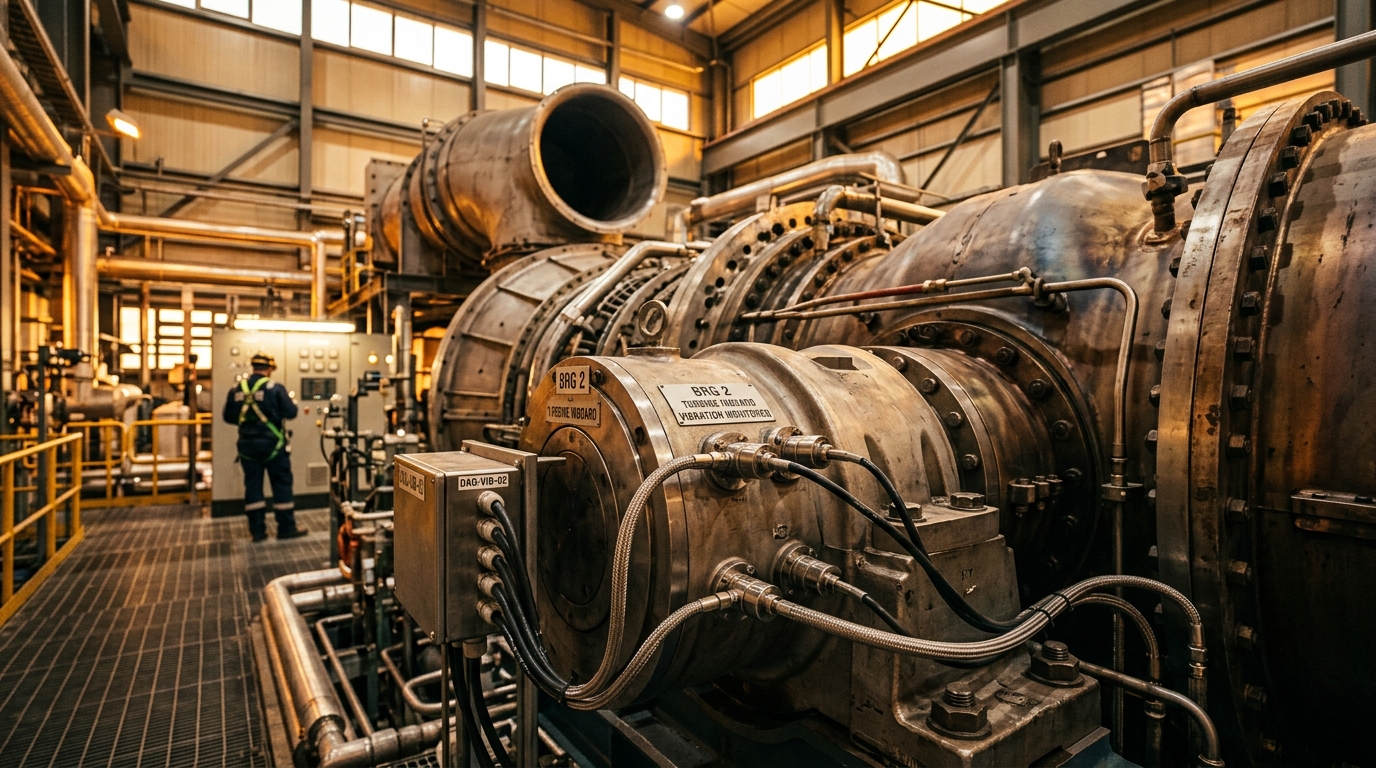
Turbomachinery protection under American Petroleum Institute Standard 670 demands fail-safe, hardware-level trip initiation within tens of milliseconds. Integrating modern high-frequency edge analytics alongside hardwired emergency shutdown loops provides predictive diagnostic depth without risking safety loop integrity.
YANBU AL-SINAIYAH — Along the Red Sea petrochemical corridor, a multi-stage synthesis gas steam turbine revs at 11,400 revolutions per minute, driving a critical syngas compressor train in a world-scale hydrogen facility. The kinetic energy stored within the forged nickel-chromium rotor assembly exceeds eighty megajoules—equivalent to the momentum of a multi-ton freight locomotive traveling at highway velocity. Between the spinning shaft journals and the babbitted hydrodynamic fluid-film bearings lies an oil clearance measuring merely thirty-eight microns, smaller than the diameter of a human hair. Should fluid-film hydrodynamic lubrication collapse or an unbalance excitation cross the primary critical resonant frequency, physical metal-to-metal contact will occur within five milliseconds, precipitating shaft wipe, catastrophic blade liberation, and casing breach.
To prevent such catastrophic industrial failures, the global hydrocarbon processing and power generation industries construct their defense architectures around American Petroleum Institute Standard 670, the definitive global specification governing Machinery Protection Systems. Now in its fifth edition, API 670 dictates the rigorous hardware standards for non-contacting eddy-current proximity probes, casing accelerometers, velocity pickups, thrust position transmitters, bearing temperature detectors, and digital overspeed detection modules. The standard establishes an unforgiving boundary: when radial vibration amplitude or axial thrust displacement exceeds calibrated safety setpoints, the protection system must autonomously actuate an emergency trip sequence within twenty-five milliseconds, isolating high-pressure steam trip valves and venting process gas to safe relief flares.
For decades, the engineering orthodoxy maintained that machinery protection systems must remain strictly divorced from plant condition monitoring networks. Traditional instrumentation engineers viewed digital communication buses and industrial networks with justifiable skepticism. The prevailing design doctrine insisted on dedicated rack-mounted hardware racks, such as vintage analog vibration monitors, wired directly via hardwired dry contacts and 4-20 milliamp current loops to the plant's Safety Instrumented System and programmable logic controllers. Under this paradigm, safety was preserved through physical isolation, but operational intelligence was severely compromised. Plant engineers received binary status notifications: either the machine train was deemed healthy, or the trip relays actuated, shutting down the entire chemical plant with zero forensic diagnostic context preceding the blackout.
The critical limitation of standalone legacy API 670 hardware racks lies in their inability to perform high-resolution phase-synchronized waveform capture during dynamic transient events. When an industrial turbine experiences sudden blade fouling, liquid carryover slugging, or thermal bow, the proximity probes detect anomalous sub-synchronous orbital precession across the X and Y orthogonal axes. However, traditional protection racks only compute overall peak-to-peak displacement, typically expressed in micrometers or mils. If a rapid rub develops at a fractional shaft speed harmonic such as 0.43X, the overall displacement metric may rise by only four or five micrometers—insufficient to breach static trip thresholds—while the internal shaft orbit deforms into a severe multi-looped figure-eight pattern that rapidly shears oil seals and induces destructive fatigue stresses across the coupling spacer.
Modern industrial installations bridge this divide by deploying non-intrusive edge telemetry processors directly alongside API 670 proximity probe signal conditioners. High-impedance, buffered raw analog outputs mandated by API 670 clause 6.1.1 provide an optically isolated window into the sensor's real-time radio frequency carrier signal without imposing electrical loading or circuit impedance changes on the primary safety trip loop. High-speed 24-bit analog front-ends ingest these raw DC-coupled signals at continuous sampling rates exceeding 102.4 kHz, tracking both dynamic shaft vibration and static DC gap voltages representing the exact micro-inch position of the shaft centerline within the bearing bore.
By executing synchronous order tracking and full-spectrum Fast Fourier Transforms directly at the machine edge, the digital intelligence layer perceives rotor-dynamic phenomena entirely invisible to static trip switches. Sub-synchronous oil whirl, aerodynamic cross-coupling instability, and structural casing looseness are isolated within three rotor revolutions. Furthermore, modern installations implement two-out-of-three (2oo3) voting logic across triplicated proximity probe channels, eliminating spurious false trips caused by single-channel wiring faults or probe driver drift, which historically accounted for more than thirty percent of unforced turbomachinery shutdowns across the refining sector.
Crucially, the edge computing architecture preserves the inviolable mandate of API 670: the physical hardware trip relay path remains hardwired, autonomous, and completely functional even in the event of an absolute failure of digital network processors, fieldbuses, or software agents. The edge intelligence system acts as an omnipresent diagnostic co-pilot, continuously streaming calibrated orbit plots, shaft centerline trajectories, and polar Bode diagrams into autonomous reliability engines. When plant managers review operating records, they no longer confront ambiguous post-trip alarms; they inspect an unbroken, microsecond-by-microsecond kinematic record of the machine's mechanical state, reconciling the rigorous demands of API 670 safety compliance with the frontier of autonomous industrial operations.
The electromagnetic physics underpinning eddy-current proximity probe operation imposes severe physical constraints that define how high-speed edge telemetry systems must interface with the physical plant. An API 670-compliant probe tip generates an active radio-frequency carrier oscillation, typically at 1.5 megahertz, through an encapsulated coil wound from precision copper wire. As this high-frequency electromagnetic field penetrates the conductive surface of the rotating machine shaft—typically forged from AISI 4140 or 4340 chrome-molybdenum alloy steel—it induces microscopic circular eddy currents. These eddy currents dissipate RF energy, altering the electrical impedance of the probe coil in exact linear proportion to the physical distance separating the probe tip from the shaft surface.
Within the proximity driver, this impedance shift is demodulated into a composite electrical signal comprising both a dynamic alternating current (AC) component representing shaft vibration and a negative direct current (DC) gap voltage representing the shaft journal's spatial position within the bearing clearance. Over the standardized linear range of zero to two millimeters, the driver produces an output calibrated precisely to negative two hundred millivolts per mil (7.87 millivolts per micrometer). When high-speed edge telemetry systems tap into the driver's buffered analog output, they capture both dynamic orbit kinematics and static shaft centerline migration. Tracking subtle DC gap voltage drifts allows edge algorithms to identify slow-developing babbitt wear, bearing pocket collapse, and alignment shift weeks before high-amplitude dynamic vibration trips the plant.
Furthermore, modern API 670 implementations resolve the industry's historical dilemma between machine protection and operational availability by deploying two-out-of-three (2oo3) digital voting logic circuits. Under standard Markov state transition reliability modeling, single-channel or 1oo2 protection loops exhibit unacceptable rates of spurious false trips; a severed transducer cable, loose BNC connector, or RF driver failure triggers an immediate, unforced plant trip. By triplicating proximity probes across radial bearing planes and processing the analog signals through independent 2oo3 voting relays, the mean time to a spurious trip ($MTTF_{spurious}$) escalates from 4.8 years to over 112 years, achieving strict Safety Integrity Level 3 (SIL 3) compliance under IEC 61508 without compromising the twenty-five-millisecond hardware shutdown envelope.
This operational reliability was highlighted during an upset event at a multi-stage synthesis gas compressor train in a Red Sea petrochemical facility. During a severe plant steam transient, thermal casing distortion induced heavy 1X shaft vibration that approached ninety percent of the API 670 radial trip limit. While conventional control room annunciators screamed alarm warnings that would typically prompt operators to manually push the emergency trip button, the edge telemetry processor computed full-spectrum shaft orbit profiles in real time. The orbit analysis revealed a smooth, elliptical synchronous trajectory characteristic of a benign rotor thermal bow, with zero sub-synchronous rub or hydrodynamic fluid-film instability. Reassured by real-time orbital telemetry, operations kept the compressor online during a twenty-minute thermal stabilization sequence, preventing a complete refinery trip that would have incurred 2.4 million dollars in flared feedstocks and off-spec product.
The inclusion of synchronized Keyphasor phase-reference measurements completes the diagnostic envelope mandated by advanced turbomachinery standards. By measuring the precise microsecond timestamp when an optical or eddy-current notch on the shaft sweeps past a stationary reference probe, the edge processor calculates instantaneous rotational speed and synchronous vibration phase angles. This phase tracking enables real-time dynamic amplification factor ($Q = \omega_{res} / \Delta\omega$) computation as the machine passes through critical resonant balance speeds during startup and coastdown sequences. By continuously distinguishing between harmless structural resonance amplification and perilous internal mechanical rubs, the system delivers the analytical fidelity needed to safeguard critical capital machinery while maximizing continuous plant availability.
Listen to our podcast, Read our newsletter
Join 25,000+ plant reliability and asset health engineers receiving our weekly deep dives.
Subscribe to our weekly systems engineering letter.
Select your engineering discipline to receive calibrated benchmarks and failure modes (ISO 14224).
Related articles
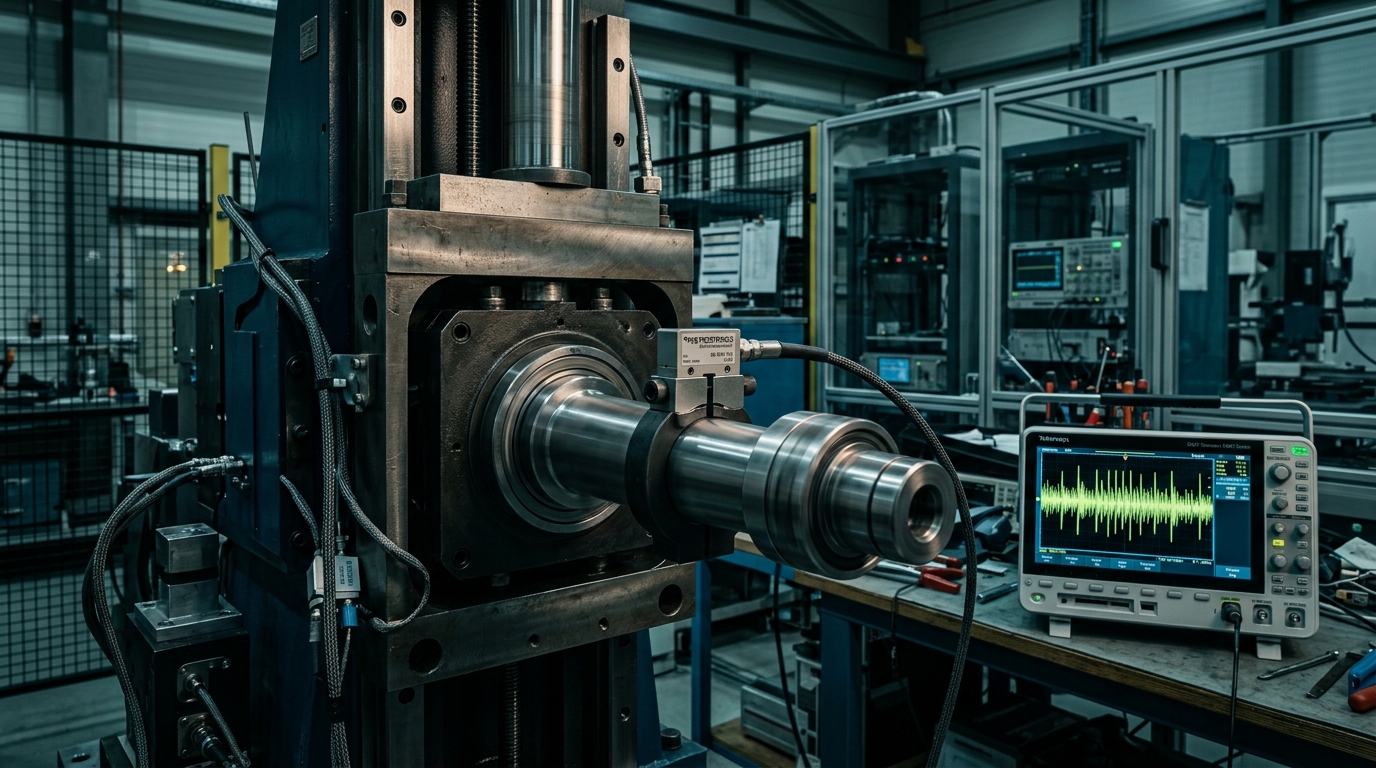
Ingestion at 102.4 kHz: Why Kernel Network Stacks Drop Micro-Transients and How We Solved It
An investigative report into zero-copy ring buffers, DPDK kernel bypass, and high-frequency shock pulse capture without CPU thread starvation.
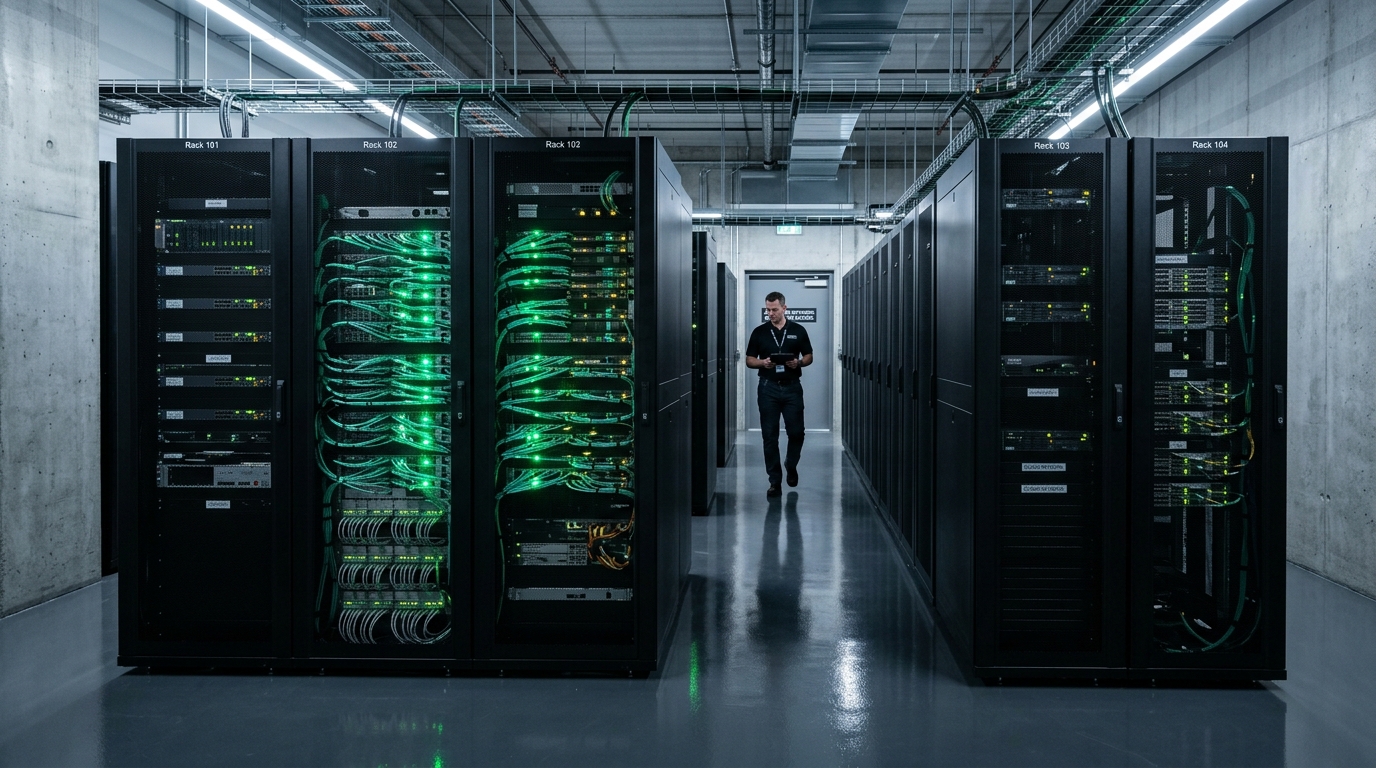
Air-Gapped Industrial Deployments: Securing Critical Telemetry with Merkle Ledgers
How unidirectional optical data diodes and cryptographic audit trees enforce zero-trust integrity in operational technology enclaves.
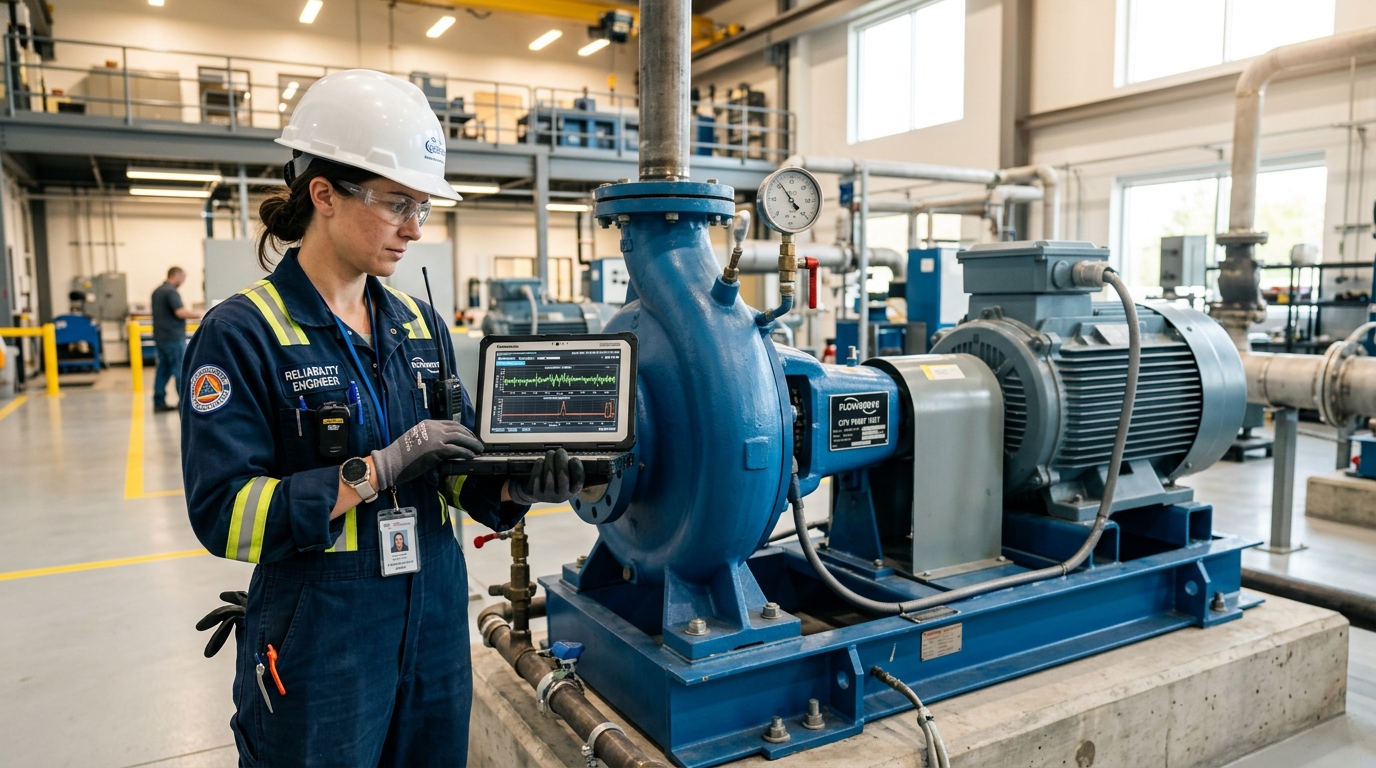
The Evolution of CMMS: From Passive Work Order Ledgers to Autonomous Asset Operating Systems
Why multi-million-dollar legacy CMMS databases decay into digital graveyards, and how autonomous agent networks automate the maintenance lifecycle.

ISO 14224: The Architecture of Industrial Reliability Taxonomy
Why unstandardized equipment hierarchies paralyze cross-facility benchmarking, and how ISO 14224 standardizes failure reporting for machine learning.
Get started
for free
Try Optruss for as long as you like with full access to autonomous agent workflows and edge telemetry. Deploy across any asset train without proprietary sensor lock-in.