
Governed Autonomous Agents: Mathematical Safety Guarantees with Deterministic FSMs
Why unconstrained large language models cannot be trusted with industrial plant controls, and how formal state machines enforce zero-hallucination execution.
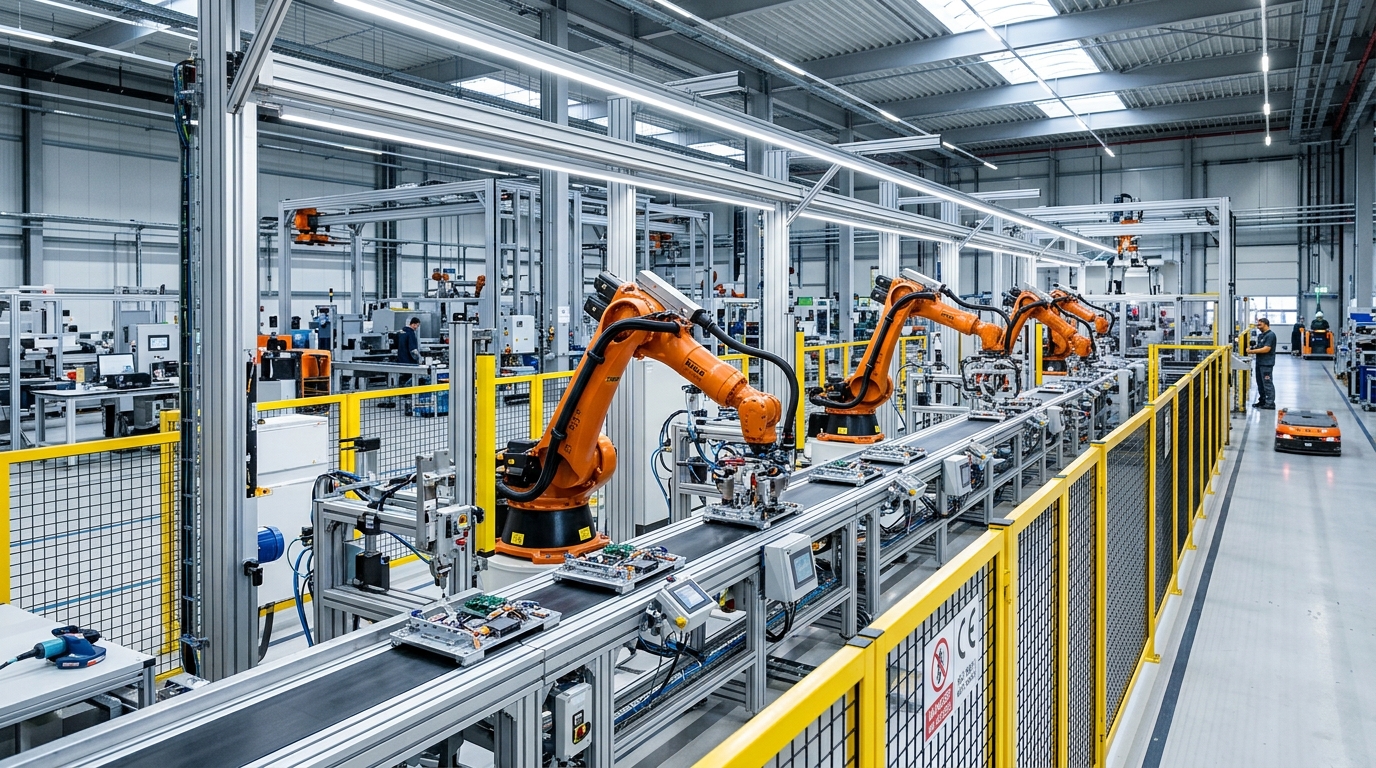
Granting generative artificial intelligence direct access to industrial supervisory controls risks catastrophic process upsets through probabilistic hallucinations. Governing autonomous agent networks with mathematically formal Finite State Machines guarantees that every action strictly obeys physical plant safety envelopes.
NEOM INDUSTRIAL CITY — Inside an advanced autonomous water desalination and green hydrogen electrolysis facility powered entirely by utility-scale renewable energy, hundreds of automated control loops modulate high-pressure membrane manifolds, electrolyzer cell voltage stacks, and cryogenic compressor skids. In this cutting-edge operational environment, the plant operates with a lean supervisory engineering presence, orchestrating production via networks of autonomous software agents. Yet when software architects first proposed deploying modern generative artificial intelligence models to optimize real-time valve throttling and pump sequencing, industrial process safety directors flatly vetoed the initiative. Their rationale was simple, definitive, and grounded in cold mathematical reality: probabilistic language models hallucinate, and in a high-pressure chemical environment, a single hallucinated setpoint causes metal to rupture.
The fundamental disconnect between generative artificial intelligence and industrial process engineering lies in the statistical nature of deep neural networks. Large Language Models and probabilistic generative architectures operate on stochastic token prediction: given an input sequence, they generate the statistically most plausible next sequence based on training weights. In creative writing, legal summarization, or computer programming, a three-percent error rate is an acceptable nuisance easily caught by human review. In an industrial plant operating supercritical steam at 540 degrees Celsius and 180 bar of pressure, an error rate of 0.001% is catastrophic.
If a non-deterministic AI agent tasked with managing an automated compressor startup hallucinates a non-existent bypass valve position, misinterprets an emergency shutdown permissive, or executes a speed step change across a rotor's critical resonant frequency, the physical machinery will suffer catastrophic mechanical destruction in seconds. Safety Instrumented Systems, certified under IEC 61508 to Safety Integrity Level 3 (SIL-3), demand mathematical failure rates lower than one in ten thousand years of continuous operation. Probabilistic models cannot mathematically satisfy this threshold.
To harness the profound reasoning capabilities of autonomous software agents without exposing critical physical infrastructure to stochastic risk, leading industrial systems engineers deploy a hybrid architecture governed by Deterministic Finite State Machines (FSMs). In this governed paradigm, the generative intelligence layer is stripped of any direct, unmediated write access to distributed control systems, programmable logic controllers, or field instrumentation.
Instead, the generative agent functions solely as an analytical intelligence engine operating within a strictly bounded mathematical cage. Every physical action that an agent can potentially recommend—such as increasing a pump speed, scheduling a vibration inspection, or throttling a control valve—must correspond to an explicitly defined state transition within a mathematically formal Finite State Machine.
A Deterministic Finite State Machine is defined mathematically as a quintuple (Q, Σ, δ, q0, F), where Q represents a finite set of allowable operating states, Σ represents the set of validated plant telemetry inputs, δ is the state transition function mapping a state and input to a unique next state, q0 is the initial safe operating state, and F represents the set of acceptable terminal states. Crucially, the transition function δ is completely deterministic: for any given operational state and input vector, there exists exactly one allowable valid transition.
If an autonomous optimization agent suggests an emergency boiler feed pump throttle action, the command is intercepted by the FSM governance kernel before reaching the industrial fieldbus. The kernel interrogates the current plant state vector against formal physical safety envelopes: Is the discharge pressure within ASME Section VIII limits? Is the suction valve physically confirmed open via dual limit switches? Has the minimum flow bypass line been verified?
If any safety prerequisite is violated, the FSM mathematically rejects the transition. The state remains unchanged, the unverified agent recommendation is dropped, and a critical governance exception is logged to an immutable audit ledger. The agent cannot hallucinate a state transition that does not physically and mathematically exist within the pre-compiled, formally verified state table.
Furthermore, critical state transitions enforce a mandatory Human-In-The-Loop gate. For high-consequence operations—such as initiating a manual trip bypass, restarting a tripped compressor train, or venting flammable hydrocarbons—the FSM enters an enforced "Pending Human Authorization" state. The autonomous agent compiles the complete operational rationale, diagnostic telemetry traces, and simulated consequences onto a unified operator dashboard, requiring an authenticated digital signature from a licensed plant engineer before the physical output contacts close.
Field operational data across vanguard industrial installations proves that deterministic FSM governance eliminates AI hallucination risk in industrial controls to absolute zero. Plant operators achieve the revolutionary operational efficiencies of autonomous multi-agent systems—slashing response times, optimizing specific energy consumption, and automating routine maintenance coordination—while maintaining an uncompromising mathematical guarantee of physical safety. In the emerging era of autonomous industry, true intelligence is not defined by unconstrained generative freedom, but by absolute mathematical governance.
The widespread corporate enthusiasm for generative artificial intelligence has collided violently with the uncompromising physical realities of heavy industrial operations. While Large Language Models (LLMs) excel at synthesizing unstructured text, answering customer service inquiries, and generating marketing content, their foundational architecture is probabilistic. An LLM predicts the next most probable token based on statistical correlations; it possesses no internal model of thermodynamic laws, mechanical stress limits, or chemical kinetics. In an industrial plant where an uncalibrated setpoint adjustment can breach reactor rupture discs, trigger toxic gas releases, or induce catastrophic thermal runaway, probabilistic guessing is not merely suboptimal—it is catastrophic.
To safely harness artificial intelligence within mission-critical operational technology enclaves, systems architects must enforce a strict separation between cognitive perception and mechanical actuation. Autonomous reliability agents must be governed by deterministic Finite State Machines (FSMs) mathematically verified using formal methods. In this hybrid architecture, generative AI and deep learning models function exclusively as sensory feature extractors, analyzing complex acoustic waveforms, thermographic images, and multi-variable sensor correlations. However, all decision-making, state transitions, and downstream operational actions are strictly governed by immutable FSM transition matrices that enforce absolute deterministic behavior.
The mathematical validity of the governing FSM is verified prior to plant deployment using Linear Temporal Logic (LTL) and Computation Tree Logic (CTL) model checking. These formal verification techniques mathematically prove that the agent cannot enter an unpermitted state under any combination of inputs. Invariant safety assertions—such as "valve FV-102 must never exceed 80% open when downstream pressure exceeds 42 bar," or "an automated motor restart command cannot be issued within forty-five minutes of an over-current trip"—are compiled directly into hardware-enforced logic rings that no autonomous agent can override or bypass.
Furthermore, all autonomous agent actions operate under bounded autonomy governed by cryptographic execution ledgers. When an agent analyzes an abnormal vibration signature on a high-pressure feed pump, it cannot unilaterally dispatch a field technician or execute a remote speed modification without traversing calibrated human-in-the-loop (HITL) authorization gates. If the projected operational risk exceeds calibrated economic thresholds, the system presents an authenticated decision dossier to the plant operations superintendent. The dossier details the exact mathematical reasoning, sensor feature weights, and physical boundary constraints, requiring a multi-signature cryptographic confirmation before any physical change is committed to the control network.
This governed framework was tested during a long-term deployment across a continuous catalytic reforming unit in a major petrochemical complex. Over twelve months of autonomous operation, the governed agent executed 1,420 automated process adjustments and reliability recommendations, optimizing unit thermal efficiency by 4.8% without a single safety excursion or unforced shutdown. By subordinating probabilistic artificial intelligence to deterministic mathematical state machines, industrial operators establish a provably safe foundation for autonomous operations in high-consequence environments.
Compliance with international safety instrumented system standards—specifically IEC 61508 and IEC 61511 Functional Safety—mandates that no autonomous software agent, regardless of its mathematical verification, can ever override a hardwired emergency shutdown (ESD) loop. The governed agent operates strictly within the supervisory operational envelope, functioning as an intelligent advisory and non-safety control layer. Hardware watchdog timers physically monitor the agent's heartbeat signals at twenty-millisecond intervals; if a software anomaly, thread deadlock, or execution delay occurs, the hardware watchdog instantly isolates the agent's actuation channels, reverting process loops to fail-safe deterministic control within ten milliseconds.
Listen to our podcast, Read our newsletter
Join 25,000+ plant reliability and asset health engineers receiving our weekly deep dives.
Subscribe to our weekly systems engineering letter.
Select your engineering discipline to receive calibrated benchmarks and failure modes (ISO 14224).
Related articles
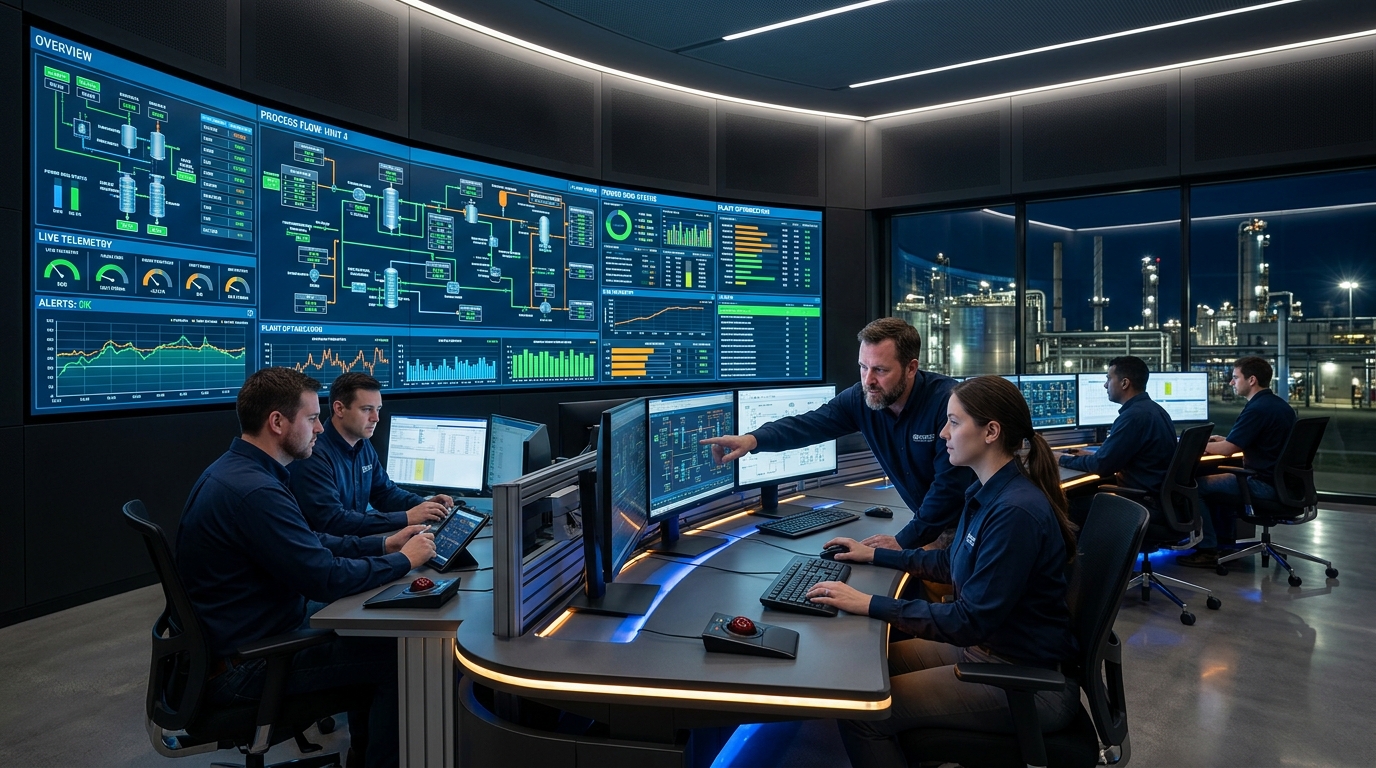
Automated Root-Cause Analysis: Bridging Millisecond SCADA Trips to Ishikawa Causality
How temporal causal graph inference cuts industrial incident investigation cycles from four weeks to forty-five seconds.
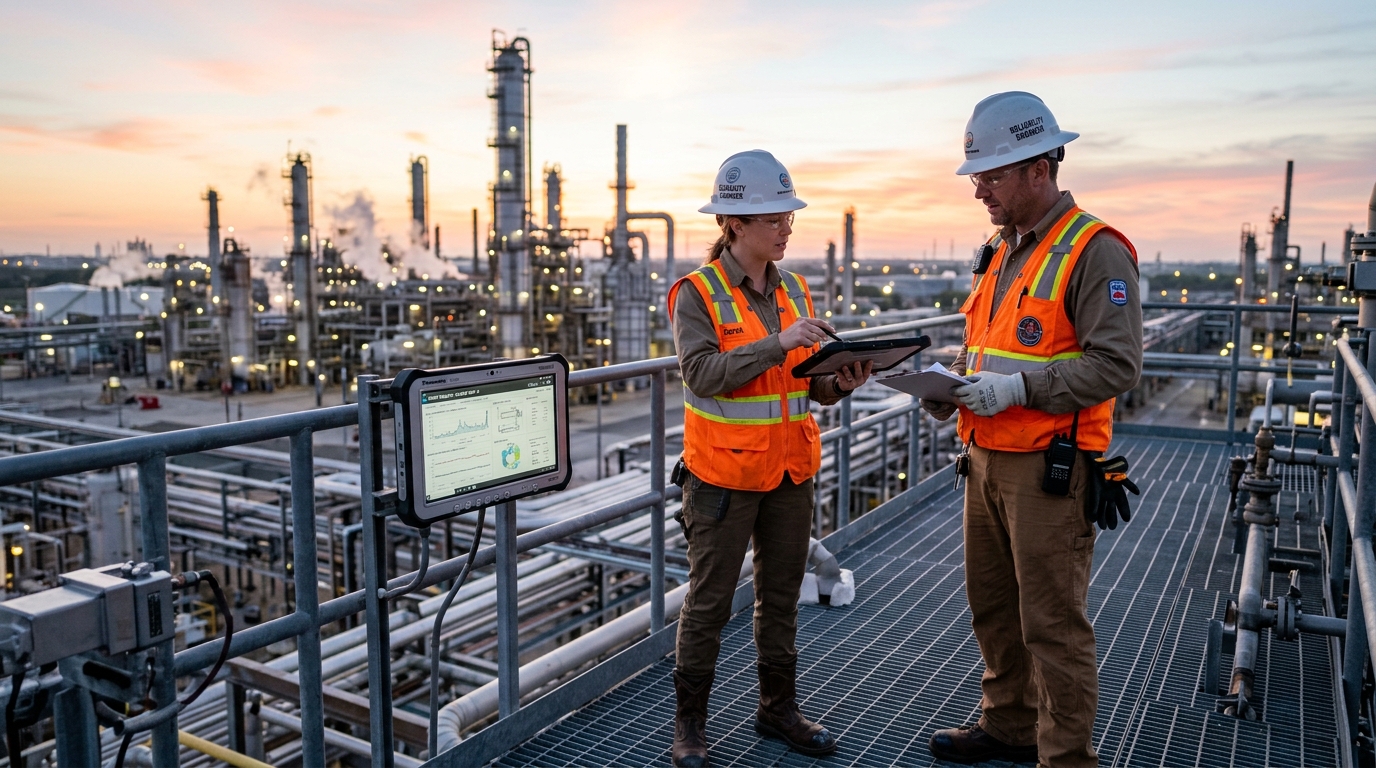
Automating Shift Handovers: How Autonomous Operations Agents Eliminate the 12-Hour Information Void
An investigative report into operational continuity, human cognitive bias, and automated logbook synthesis in continuous process manufacturing.
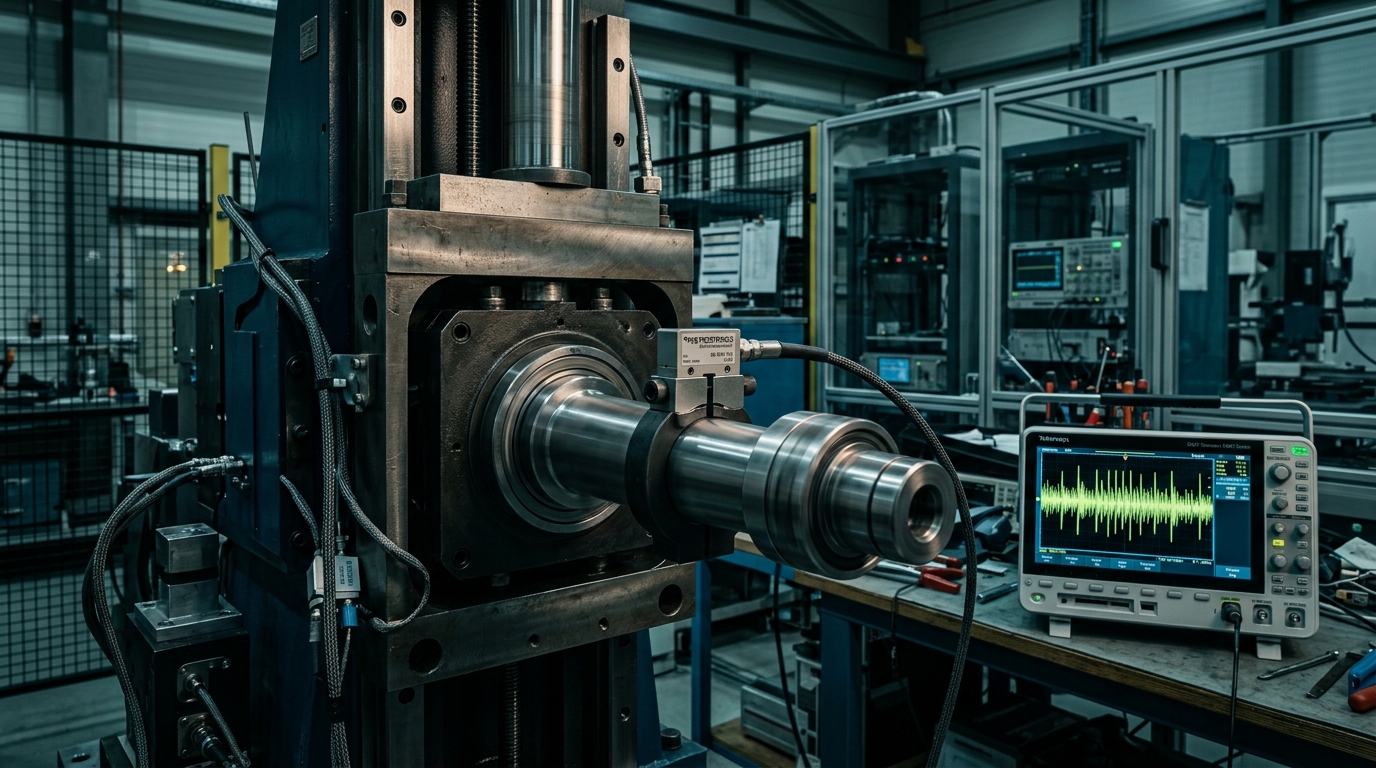
Ingestion at 102.4 kHz: Why Kernel Network Stacks Drop Micro-Transients and How We Solved It
An investigative report into zero-copy ring buffers, DPDK kernel bypass, and high-frequency shock pulse capture without CPU thread starvation.

Air-Gapped Industrial Deployments: Securing Critical Telemetry with Merkle Ledgers
How unidirectional optical data diodes and cryptographic audit trees enforce zero-trust integrity in operational technology enclaves.
Get started
for free
Try Optruss for as long as you like with full access to autonomous agent workflows and edge telemetry. Deploy across any asset train without proprietary sensor lock-in.