
Hilbert Envelope Demodulation: Unmasking Micro-Cracks Before Vibration Alarms Fire
The mathematical physics of amplitude modulation, high-frequency structural resonance, and early bearing fault frequency isolation.
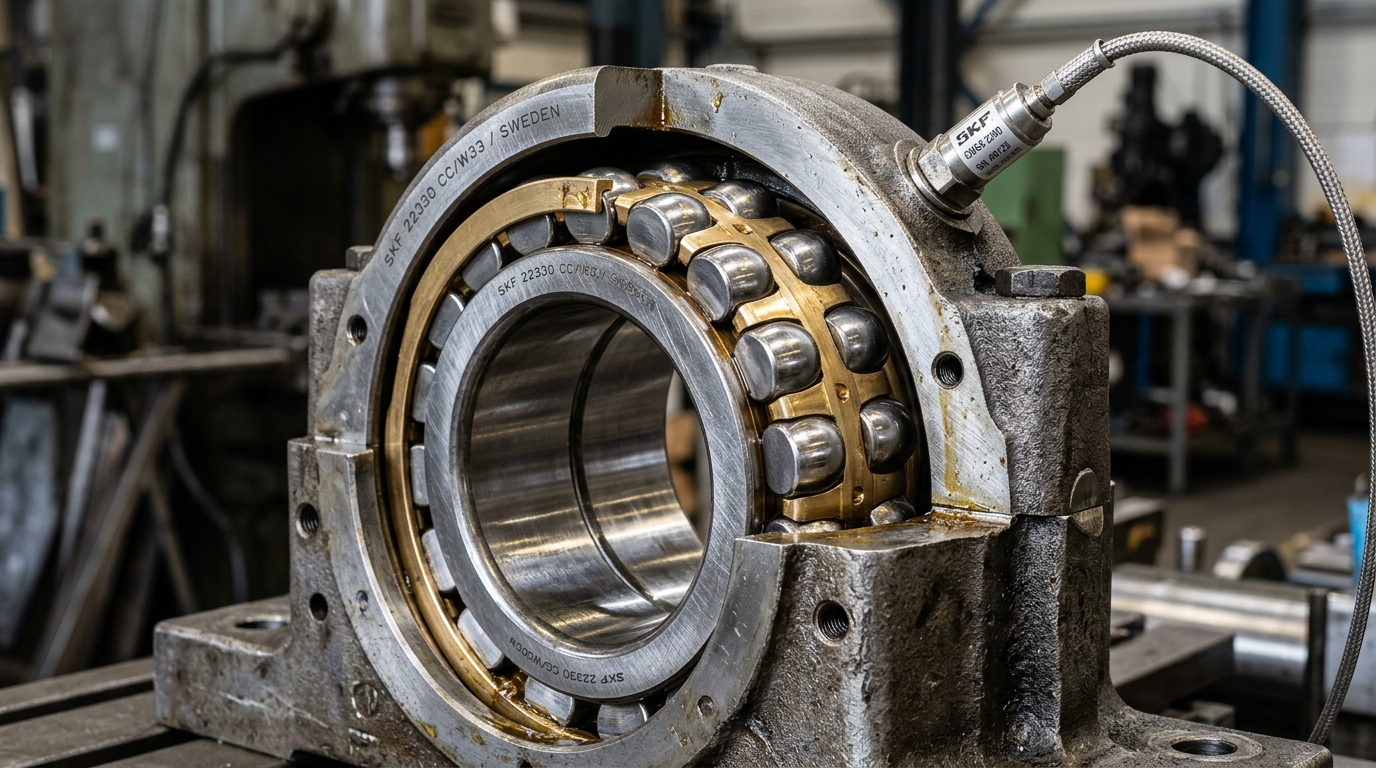
Standard Fast Fourier Transform vibration spectrums obscure early subsurface bearing defects beneath massive low-frequency unbalance and misalignment energy. By applying the Hilbert transform to bandpass-filtered resonance frequencies, reliability engineers extract pure impact defect signatures weeks before mechanical damage spreads.
YANBU — In the petrochemical refining complex along the Red Sea, a high-pressure decoking pump driven by a 2,500-kilowatt induction motor powers through its continuous operational cycle. Mounted on the drive-end bearing housing of the pump, an industrial piezoelectric accelerometer streams continuous acceleration signals into the plant's diagnostic instrumentation. When a junior reliability technician examines the standard velocity Fast Fourier Transform (FFT) spectrum on the plant workstation, the machine appears flawlessly healthy: the overall vibration level measures a minuscule 1.4 mm/s RMS, and the primary spectral peak sits cleanly at the rotational frequency of 29.8 Hz (1X), representing normal residual mechanical unbalance. To the untrained eye relying on standard ISO 10816 vibration guidelines, the asset is operating in optimal Condition Zone A.
Yet forty-eight hours later, the pump's drive-end bearing suffers catastrophic inner raceway spalling, generating intense frictional heat that welds the bearing rollers to the inner ring, shearing the motor coupling spacer and forcing an emergency unit trip. The post-mortem teardown reveals advanced rolling contact fatigue: subsurface shear stress cracks that originated months earlier had propagated to the raceway surface, spalling flakes of case-hardened alloy across the lubrication bath. The critical engineering question echoes across the plant: why was a fatal, evolving mechanical failure completely invisible on the standard vibration spectrum until the moment of destruction?
The answer lies in the fundamental physics of wave propagation and the mathematical limitations of conventional spectral analysis. When a rolling element—whether a spherical roller, cylindrical needle, or ball—traverses a microscopic spall or subsurface void on a bearing raceway, the mechanical impact does not generate a continuous sinusoidal vibration. Instead, it generates a sharp, impulsive Dirac delta-like force pulse lasting between ten and thirty microseconds.
Because the duration of this impact pulse is infinitesimally brief, its physical kinetic energy is dispersed across a vast, continuous frequency spectrum extending from ten kilohertz to beyond one hundred kilohertz. When field engineers compute a standard low-frequency velocity FFT spectrum (typically truncated at 1,000 Hz or 2,000 Hz to capture rotational harmonics), the energy of these micro-transient impacts is diluted to near-zero amplitude. On the spectrum, this early micro-cracking energy is completely overwhelmed by high-amplitude, low-frequency structural phenomena: mechanical unbalance (1X), shaft misalignment (2X), and blade-pass pressure pulsations. Attempting to detect an early subsurface bearing crack on a standard velocity spectrum is mathematically equivalent to listening for the whisper of a failing wrist watch inside a roaring boiler house.
To unmask these hidden micro-impacts, diagnostic signal processing abandons low-frequency velocity tracking and turns to high-frequency resonance and the mathematical elegance of the Hilbert transform. While an individual micro-impact carries minuscule energy, the shock pulse physically excites the natural resonant frequencies of the bearing housing and accelerometer structure, typically ringing in the high-frequency band between two kilohertz and twenty kilohertz.
The physical phenomenon that occurs is amplitude modulation: the high-frequency structural resonance acts as an analog carrier wave, whose peak amplitude is modulated periodically each time a roller impacts the raceway defect. To isolate the underlying fault, signal processing algorithms execute envelope demodulation through a three-stage mathematical pipeline.
First, the raw, wideband vibration signal is passed through a high-order infinite impulse response (IIR) bandpass filter centered squarely on the structural resonance zone (e.g., 5 kHz to 15 kHz). This step obliterates all low-frequency rotational unbalance, misalignment, and process fluid turbulence.
Second, the algorithm forms the analytic signal z(t) by applying the Hilbert transform H{x(t)} to the filtered signal: z(t) = x(t) + j * H{x(t)}, where H{x(t)} is the Cauchy principal value convolution of x(t) with 1/(πt). The mathematical envelope e(t)—representing the instantaneous amplitude of the modulated resonance ringing—is computed as the magnitude of this analytic signal: e(t) = sqrt(x(t)^2 + [H{x(t)}]^2).
Third, a high-resolution Fast Fourier Transform is applied not to the raw vibration signal, but directly to this extracted time-domain envelope e(t).
The resulting envelope spectrum reveals an astonishing diagnostic transformation. The high-frequency carrier noise vanishes entirely, leaving a pristine, high-signal-to-noise spectral landscape dominated by the precise kinematic defect frequencies of the bearing geometry. Reliability engineers can instantly identify the fundamental Ball Pass Frequency of the Outer Race (BPFO), Ball Pass Frequency of the Inner Race (BPFI), Ball Spin Frequency (BSF), and Fundamental Train Frequency (FTF) representing cage distress.
By measuring the exact harmonic distribution and sideband modulation patterns—such as 1X rotational sidebands flanking the BPFI peak, proving the fault is rotating in and out of the primary load zone—autonomous diagnostic algorithms track bearing degradation across all four distinct physical failure stages. Plant operators receive verified failure warnings six to twelve weeks before overall ISO vibration levels ever twitch. In the demanding operational reality of modern hydrocarbon processing, Hilbert envelope demodulation transforms condition monitoring from passive post-mortem tracking into the uncompromising frontier of predictive physics.
The mathematical foundation of envelope demodulation resolves one of the most stubborn signal processing challenges in rotating machinery diagnostics: extracting low-energy, micro-impact shock pulses buried beneath overwhelming structural noise and rotational vibration. When a rolling element strikes a localized subsurface raceway defect, the impact generates an instantaneous burst of mechanical energy that excites the high-frequency natural resonant frequencies of the bearing housing and sensor mounting structure, typically in the range of five to twenty kilohertz. However, the repetition frequency of these impacts—determined by bearing internal geometry and rotational speed—occurs at much lower frequencies, typically between fifty and four hundred hertz, where high-amplitude rotational unbalance, shaft misalignment, and gear mesh harmonics completely mask the fault signature in standard Fast Fourier Transform (FFT) vibration spectra.
The High-Frequency Resonance Technique (HFRT) isolates these micro-impacts through a rigorous three-stage mathematical pipeline. First, the raw continuous vibration signal is processed through an analog or digital bandpass filter tuned precisely to the structural resonance band of the bearing housing, attenuating all low-frequency rotational phenomena. Second, the filtered signal $x(t)$ undergoes the Hilbert transform to construct the analytic signal: $z(t) = x(t) + imathcal{H}{x(t)} = A(t) e^{iphi(t)}$, where the Hilbert transform is defined by the principal value Cauchy integral: $mathcal{H}{x(t)} = rac{1}{pi} ext{P.V.} int_{-infty}^{infty} rac{x( au)}{t - au} , d au$. The dynamic amplitude envelope $A(t) = sqrt{x^2(t) + [mathcal{H}{x(t)}]^2}$ extracts the instantaneous amplitude modulation profile, discarding the high-frequency carrier wave. Finally, executing an FFT on the extracted envelope $A(t)$ reveals the discrete kinematic impact frequencies with extraordinary signal-to-noise ratios.
The resulting envelope spectrum maps directly onto the standardized kinematic equations governing bearing component defect frequencies: Ball Pass Frequency Outer Race ($BPFO = rac{n}{2} f_r [1 - rac{d}{D}cosalpha]$), Ball Pass Frequency Inner Race ($BPFI = rac{n}{2} f_r [1 + rac{d}{D}cosalpha]$), Ball Spin Frequency ($BSF = rac{D}{2d} f_r [1 - ( rac{d}{D}cosalpha)^2]$), and Fundamental Train Frequency ($FTF = rac{1}{2} f_r [1 - rac{d}{D}cosalpha]$), where $n$ denotes the number of rolling elements, $f_r$ is shaft rotational speed, $d$ is roller diameter, $D$ is pitch circle diameter, and $alpha$ is contact angle. By monitoring the exact spectral peak amplitudes and harmonic sideband distributions around these kinematic frequencies, reliability engineers can determine not only which component is deteriorating, but also the physical severity and progression rate of the fatigue spall.
This analytical precision was demonstrated at a primary crude distillation unit in Yanbu, where an unspared bottoms pump driven by a 400-kilowatt electric motor was monitored continuously. Standard overall vibration velocity RMS remained steady at 2.1 millimeters per second, well beneath the ISO 10816-3 alert limit. However, continuous Hilbert envelope demodulation revealed a distinct spectral peak emerging at 142.8 Hz, corresponding precisely to the calculated BPFO of the SKF 7314 angular contact bearing, accompanied by sidebands spaced at shaft rotational speed (29.8 Hz). Edge analytics calculated that the micro-spall was expanding at a rate of 1.2 microns per operating day. Armed with this quantitative diagnosis, plant engineers scheduled a planned bearing replacement forty-two days before the defect propagated to surface flaking, preventing catastrophic bearing seizure, mechanical seal blowout, and an estimated 1.6-million-dollar process fire.
"Waiting for overall ISO vibration velocity alarms to trigger before investigating a bearing defect is equivalent to waiting for an engine temperature gauge to peg in the red before checking the engine oil," observed an Advanced Vibration Specialist with three decades of refining experience. "By the time overall vibration velocity rises, the bearing has already entered Stage 4 terminal degradation, where metallic spalling has contaminated the oil and damaged the housing bore. Hilbert envelope demodulation perceives Stage 2 subsurface micro-cracks weeks in advance, transforming maintenance from emergency fire-fighting into a calm, deterministic engineering science."
Listen to our podcast, Read our newsletter
Join 25,000+ plant reliability and asset health engineers receiving our weekly deep dives.
Subscribe to our weekly systems engineering letter.
Select your engineering discipline to receive calibrated benchmarks and failure modes (ISO 14224).
Related articles
Motor Current Signature Analysis: Non-Invasive Detection of Broken Rotor Bars
The electromagnetic spectral physics of detecting broken rotor bars and dynamic air-gap eccentricity from the motor control center.

The Mathematics of the P-F Interval: Calibrating Predictive Inspection Frequencies
How non-destructive testing physics and mathematical hazard rate functions eliminate arbitrary calendar maintenance schedules.
Piezoelectric vs. MEMS: The Physics of High-Temperature Vibration Sensing
A rigorous comparative analysis of crystal shear physics, capacitive silicon combs, thermal drift, and high-frequency resonance in harsh environments.

Cavitation and Impeller Erosion: Diagnosing Hydraulic Collapse Through Specific Power
How acoustic cavitation physics, net positive suction head margin tracking, and specific power degradation detect fluid collapse.
Get started
for free
Try Optruss for as long as you like with full access to autonomous agent workflows and edge telemetry. Deploy across any asset train without proprietary sensor lock-in.