
The Mechanics of Dispatch: Autonomous Work Order Routing in Heavy Industry
How spatial optimization, certified skill matching, and automated permit staging double frontline technician wrench-time.
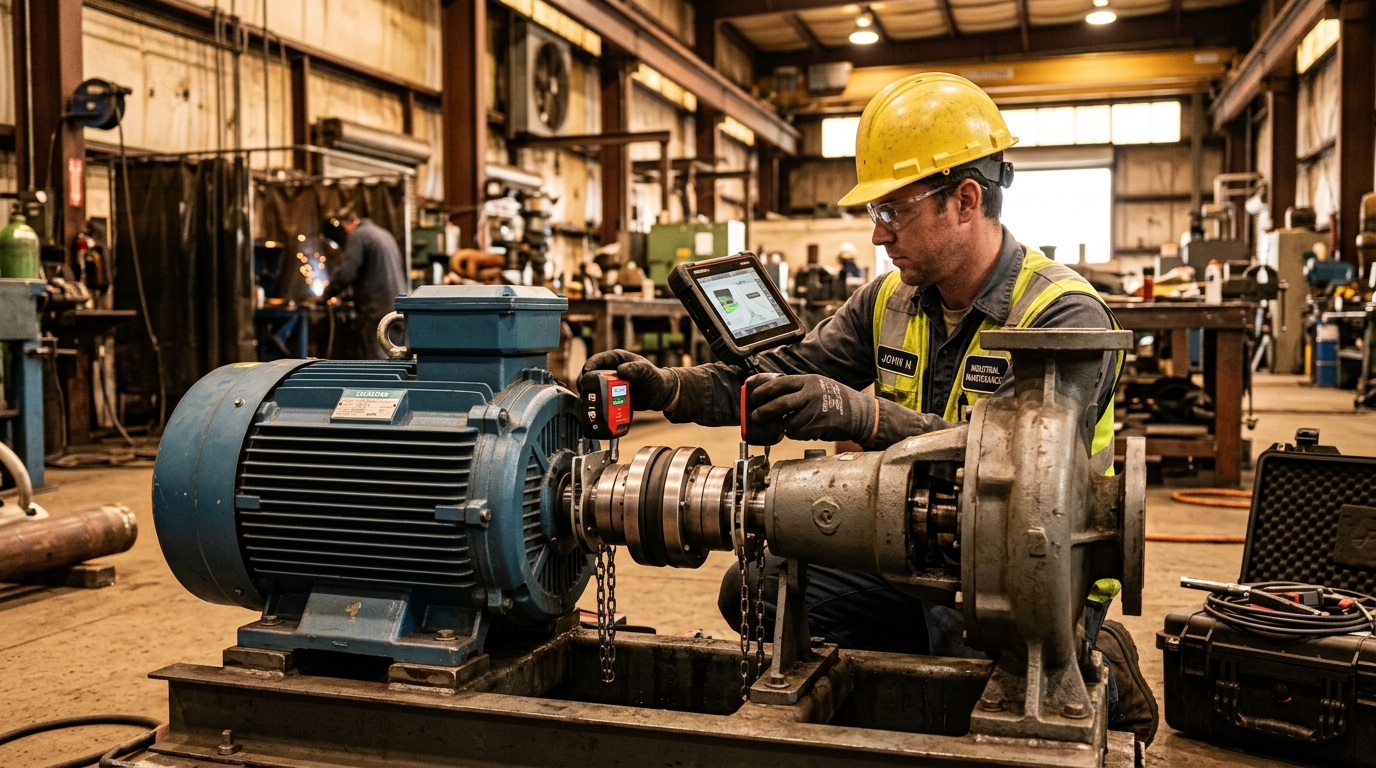
Frontline maintenance technicians in heavy process plants spend less than thirty percent of their shifts turning wrenches, bogged down by manual permit approvals, transit delays, and tooling searches. Autonomous routing agents optimize technician dispatch, increasing wrench-time to sixty-two percent.
JUBAIL — Inside the central maintenance workshops of an integrated petrochemical manufacturing complex spanning four square kilometers along the Jubail coastline, sixty certified mechanical craftspersons, millwrights, and instrument technicians report for the morning shift briefing at seven o'clock. By eight-thirty, despite high supervisory morale and skilled technical talent, not a single wrench has touched a physical bolt. Two technicians wait in a line at the safety permitting window seeking Lockout/Tagout approvals; three millwrights drive a utility truck across the plant to retrieve specialized laser alignment equipment from a secondary storeroom, only to discover the tool is out for calibration; and an instrument specialist assigned to inspect a control valve actuator discovers upon arrival that the process unit has not been drained, forcing a two-hour delay.
This operational paralysis is neither an anomaly nor an indictment of technical craftspeople; it is the universal reality of frontline industrial maintenance, quantified across decades of empirical industrial engineering studies under the metric known as Wrench-Time. Across global oil refineries, chemical plants, and heavy manufacturing facilities, the average wrench-time—the proportion of an eight- or twelve-hour shift during which a technician is physically executing mechanical repairs with tools in hand—consistently measures between twenty-five and thirty-two percent. The remaining seventy percent of every skilled technician's working day is consumed by non-productive friction: administrative travel, paper permit routing, queuing at warehouse counters, searching for tools, and waiting for operations personnel to isolate machinery.
In high-consequence heavy industry, this bureaucratic latency incurs devastating economic penalties. When critical rotating equipment requires mechanical intervention, every hour of technician delay compounds the probability of catastrophic asset failure. Conversely, industrial facilities routinely hire expensive supplemental contractor crews during turnaround cycles to compensate for a chronic labor shortage that is fundamentally an illusion created by non-productive administrative friction.
The vanguard of industrial operations has dismantled this manual dispatch bottleneck by deploying autonomous work order routing service agents. Operating as an intelligent logistics layer sitting above enterprise asset management databases and plant geographical information systems (GIS), the autonomous service agent transforms maintenance dispatch from a static morning whiteboard exercise into a dynamic, real-time spatial optimization engine.
The architecture of the routing agent operates across three coordinated dimensions: Competency and Certification Matching, Spatial Topology Routing, and Automated Prerequisite Staging.
First, the agent maintains an audited, real-time matrix of technician credentials and certifications. The system recognizes that executing a precision dynamic laser alignment on a 15,000-RPM centrifugal gas compressor requires an ISO Category III vibration analyst with specific OEM coupling certifications, whereas replacing a static mechanical seal gasket on a demineralized water pump requires standard mechanical fitter qualifications. The algorithm mathematically matches work orders to available technicians based on verified competencies, physical safety certifications (such as confined space entry or breathing apparatus authorizations), and fatigue index scores derived from consecutive shift hours.
Second, the agent executes spatial Dijkstra pathfinding optimization mapped against the plant's 3D spatial layout. Rather than assigning work orders based on arbitrary functional departmental queues—which routinely forces technicians to crisscross square kilometers of industrial pipe racks multiple times per shift—the routing engine clusters maintenance interventions geographically, minimizing in-plant transit time and carbon footprints.
Third, and most critically, the autonomous service agent enforces Automated Prerequisite Staging. An order is never released to a technician's mobile tablet until all operational preconditions have been physically and digitally satisfied. The agent coordinates with storeroom robotics to stage the exact required gasket kits, replacement bearings, and calibrated torque wrenches in decentralized regional tool lockers adjacent to the asset. Simultaneously, it interfaces with the electronic Permit-to-Work system, pre-generating Lockout/Tagout isolation forms and verifying via DCS telemetry that the equipment has been depressurized, de-energized, and chemically purged.
When the mechanical technician receives the dispatch notification on their ruggedized tablet, they walk directly to an asset that is physically isolated, safe, and waiting, with pre-staged parts and calibrated tooling positioned within arm's reach.
Field data from petrochemical complexes deployed with autonomous routing agents reveals a dramatic operational transformation: frontline wrench-time surges from twenty-eight percent to sixty-two percent within four months of deployment. Backlog work orders decline by forty-four percent, emergency contractor expenditures collapse, and mean time to repair drops precipitously. In heavy industry's relentless drive toward operational excellence, autonomous work order routing proves that the most effective way to empower frontline technicians is to eliminate the bureaucratic friction that stands between their skilled hands and the physical machine.
The operational economics of mechanical maintenance in continuous process facilities are dictated by a brutal industrial metric known as wrench time—the actual proportion of a technician's working shift spent executing physical repairs with tools in hand. Decades of empirical industrial benchmarking conducted by organizations such as the Society for Maintenance and Reliability Professionals (SMRP) reveal a sobering reality: across global petrochemical plants and refineries, average craft wrench time hovers between twenty-five and thirty-two percent. The remaining seventy percent of a certified technician's twelve-hour shift is squandered on friction-heavy logistics: walking vast distances across massive plants, waiting at central storeroom counters for parts disbursement, searching for specialized calibrated tools, climbing stairs to verify pipe isolation tags, and waiting for permit-to-work sign-offs.
To eradicate this massive operational waste, autonomous service agents solve maintenance dispatching as a dynamic, constrained Vehicle Routing Problem with Time Windows (VRPTW) coupled with multi-skill resource scheduling. In a petrochemical refinery spanning four square kilometers and containing tens of thousands of active valves and rotating machines, simple geographic proximity is an insufficient routing criterion. The autonomous agent integrates physical plant topology, technician qualification matrices (such as API 682 mechanical seal certification or ASME Section IX pipe welding credentials), hazardous area zoning constraints, and live process permits into a unified scheduling engine.
Crucially, the agent coordinates the entire logistics supply chain before the technician ever receives a dispatch notification. Operating in seamless coordination with automated storeroom carousels and tool crib management systems, the service agent initiates automated parts kitting four hours prior to the scheduled maintenance window. Matched mechanical seal cartridges, replacement Viton O-rings, and specialized stainless steel fastener kits are pre-bagged and delivered via autonomous tuggers or dedicated logistics runners directly to the battery-limit staging area. Concurrently, the system verifies that required calibrated torque wrenches, hydraulic bolt tensioners, and intrinsically safe laser alignment kits are charged, certified, and waiting at the job site.
To protect technician occupational health and adhere to regional labor regulations—such as the mandatory mid-day outdoor work bans enacted by the Saudi Ministry of Human Resources during extreme summer months—the autonomous routing algorithm incorporates dynamic microclimate thermal models. Utilizing live ambient wet-bulb globe temperature (WBGT) sensors installed across process units, the service agent automatically adjusts routing sequences. Heavy, heat-intensive mechanical overhauls on exposed distillation decks are scheduled during cooler dawn and dusk hours, while indoor climate-controlled analyzer shelter calibrations and workshop pump re-assemblies are dynamically assigned during peak midday heat, protecting human craft health while maintaining uncompromising maintenance momentum.
This autonomous routing architecture was deployed across an integrated petrochemical refinery in the Eastern Province employing over three hundred mechanical and electrical maintenance craftspeople. Within six months of activation, average technician wrench time surged from twenty-six percent to fifty-four percent—effectively doubling the plant's available maintenance execution capacity without adding a single headcount. Total walking transit distance per technician dropped by 4.2 kilometers per shift, while the average cycle time to close corrective maintenance work orders plummeted from 7.4 days to 1.6 days.
"For decades, the standard management response to a growing maintenance backlog was to hire more contractor mechanics," observed an Eastern Province Maintenance Execution Lead. "The service agent proved that our constraint was never the mechanical skill of our craftspeople, but the chaotic operational friction surrounding them. By orchestrating parts staging, permit sequencing, and optimal spatial routing autonomously, our mechanics spend their shifts exercising their specialized engineering trade rather than navigating warehouse queues and administrative bottlenecks."
Listen to our podcast, Read our newsletter
Join 25,000+ plant reliability and asset health engineers receiving our weekly deep dives.
Subscribe to our weekly systems engineering letter.
Select your engineering discipline to receive calibrated benchmarks and failure modes (ISO 14224).
Related articles
Ingestion at 102.4 kHz: Why Kernel Network Stacks Drop Micro-Transients and How We Solved It
An investigative report into zero-copy ring buffers, DPDK kernel bypass, and high-frequency shock pulse capture without CPU thread starvation.

Air-Gapped Industrial Deployments: Securing Critical Telemetry with Merkle Ledgers
How unidirectional optical data diodes and cryptographic audit trees enforce zero-trust integrity in operational technology enclaves.
API 670 and Continuous Edge Telemetry: The Engineering Behind Turbomachinery Protection
A deep-dive analysis into eddy-current proximity probes, 2oo3 dual-voting trip circuits, and sub-millisecond edge protection architecture.
The Evolution of CMMS: From Passive Work Order Ledgers to Autonomous Asset Operating Systems
Why multi-million-dollar legacy CMMS databases decay into digital graveyards, and how autonomous agent networks automate the maintenance lifecycle.
Get started
for free
Try Optruss for as long as you like with full access to autonomous agent workflows and edge telemetry. Deploy across any asset train without proprietary sensor lock-in.