Migrating Legacy Maximo to Directed Asset Graphs in 14 Days
A field report on zero-downtime ETL pipelines, preserving twenty years of historical work orders, and breaking free from monolithic relational tables.
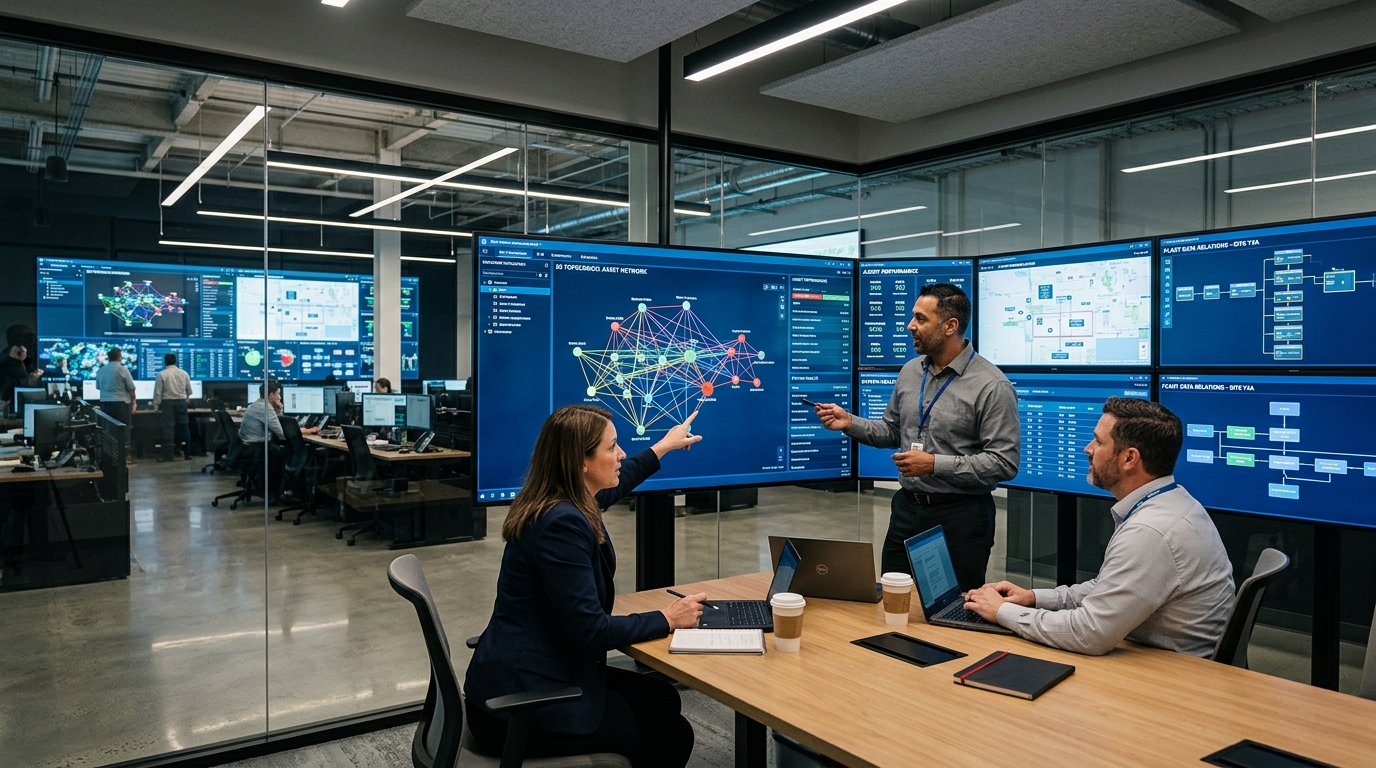
Multi-decade legacy relational databases trap industrial maintenance history in rigid, denormalized SQL tables incapable of modeling modern sensor telemetry and multi-variable asset relationships. Migrating enterprise records to a directed acyclic asset graph in fourteen days unlocks real-time operational intelligence without operational downtime.
RIYADH — In the data center annex of a sovereign chemical refining enterprise operating on the Arabian Gulf, a systems architect opens an Oracle SQL terminal connected to a production database supporting IBM Maximo Release 7.6. The schema underlying this monolithic enterprise asset management platform reflects twenty-two continuous years of accumulated customizations, third-party database triggers, and fragmented patch histories. Within the primary 'WORKORDER' table alone lie 4.2 million discrete rows distributed across 280 denormalized columns, interlaced with convoluted foreign-key constraints linking to 'ASSET', 'LOCATIONS', 'FAILUREREPORT', and 'ITEM' tables. A simple analytical query attempting to trace recurring bearing failure patterns across all horizontal pumps driven by medium-voltage induction motors requires twelve relational table joins and consumes forty-two minutes of server compute time, routinely locking production tables and causing timeout errors on plant operator mobile terminals.
This database gridlock exemplifies the architectural crisis paralyzing legacy enterprise asset management systems across the industrial sector. Developed in an era when enterprise computing centered on centralized relational databases designed for accounting audits, systems like IBM Maximo and SAP Plant Maintenance (PM) model physical reality through rigid tables, foreign keys, and static parent-child asset trees.
In an industrial plant, however, physical engineering reality is fundamentally non-hierarchical; it is an interconnected topological network. A high-pressure steam boiler does not merely possess a static parent-child relationship to a steam header. It participates in a complex, multi-dimensional directed graph: thermodynamic relationships linking boiler water conductivity to turbine blade deposition; electrical relationships linking motor control center switchgear to pump trip loops; process safety relationships linking relief valves to flare headers; and spatial relationships linking physical equipment to hazardous gas detection zones.
Attempting to model these multi-dimensional engineering dependencies within relational SQL schemas leads to severe schema brittleness, catastrophic query latency, and an inability to ingest high-frequency edge sensor telemetry. When enterprise leadership proposes modernizing these platforms, conventional systems integrators deliver staggering proposals: three-year migration timelines, millions of dollars in consulting fees, and catastrophic production blackout windows.
Forward-looking industrial operators have pioneered an alternative modernization methodology: migrating twenty years of relational Maximo records to a directed acyclic Asset Graph in exactly fourteen business days, with zero operational downtime and absolute preservation of historical audit trails.
The technical execution of this rapid migration relies on a high-throughput, streaming Extract-Transform-Load (ETL) pipeline implemented in Rust and Apache Arrow, decoupling source production systems through database change data capture (CDC).
During Days 1 through 4, the migration pipeline attaches to the production database via transactional redo log readers, extracting the complete relational schema—including custom tables, work order history, job plans, failure codes, and spare part catalogs—into immutable Parquet data lakes in RAM. Crucially, the production database experiences less than one percent CPU overhead and zero table locking.
During Days 5 through 9, the transform engine translates relational foreign-key topologies into a formal directed property graph. Physical assets, functional locations, spare parts, and operating manuals are mapped as typed Vertices (Nodes). Engineering relationships—such as 'DRIVES', 'FEEDS_INTO', 'PROTECTED_BY', 'SPARE_FOR', and 'CALIBRATED_TO'—are instantiated as directed Edges containing rich metadata properties, including installation timestamps, piping diameters, and electrical ratings.
During Days 10 through 12, twenty years of unstructured work order free-text and historic PDF inspection reports pass through natural language entity extraction engines, linking historical failure descriptions directly to standardized ISO 14224 failure taxonomy nodes on the graph.
During Days 13 and 14, the asset graph platform goes live in parallel shadow execution. Real-time bi-directional connectors synchronize changes between the legacy Maximo front-end and the new asset graph platform, allowing plant personnel to transition seamlessly without disruption to ongoing plant operations.
The operational results achieved across Gulf industrial deployments are profound. Complex analytical queries that previously locked Oracle databases for forty-two minutes execute across the distributed graph engine in less than eighteen milliseconds. An engineer querying for all critical pumps subject to recurring cavitation whose upstream suction strainers lack differential pressure transmitters receives an instantaneous visual graph traversal. Most importantly, the directed asset graph provides the foundational topological backbone required to deploy autonomous predictive maintenance agents, liberating decades of buried industrial history and transforming a sluggish administrative database into a high-speed engine of operational intelligence.
For three decades, enterprise asset management across the heavy process industries has been anchored in IBM Maximo and its underlying relational database schemas. While Maximo established vital commercial discipline for maintenance budgeting, purchase order generation, and regulatory audit tracking, its relational architecture—built on deeply normalized relational tables including ASSET, LOCATIONS, WORKORDER, and PLUSCFMATTR—imposes severe architectural constraints on modern condition monitoring. To evaluate how an upstream pressure fluctuation in an olefins fractionation line impacts a mechanical seal flush failure on a bottoms pump, a relational database must execute costly multi-table inner joins across millions of rows, introducing multi-second query latencies that paralyze real-time autonomous systems.
Modernizing these massive enterprise repositories into native property graphs requires a deterministic, zero-downtime migration methodology that preserves decades of audit histories while translating static tables into high-velocity graph topologies. The fourteen-day migration framework executes across four calibrated phases. Days 1 through 3 execute automated schema reflection and ontology mapping: relational tables are decompiled into native graph entities where primary keys become discrete nodes (such as :Asset, :Location, :WorkOrder, and :FailureMode) and foreign key relationships are converted into first-class directed edges (such as [:LOCATED_IN], [:FEEDS], [:POWERS], and [:PROTECTED_BY]).
Days 4 through 7 deploy distributed streaming extract-transform-load (ETL) pipelines using Apache Kafka and Debezium change-data-capture (CDC) connectors. Historical tables containing decades of maintenance records, component hierarchies, and labor transactions are streamed into the graph database engine, where automated entity resolution algorithms merge duplicate asset tags and reconcile discrepancies between piping diagrams and legacy asset registers. Days 8 through 10 establish live bidirectional CDC replication, ensuring that any work order update, inventory deduction, or meter reading occurring in legacy systems is mirrored in the asset graph with sub-second synchronization latency.
The operational superiority of the asset graph is especially stark when executing recursive bill-of-materials (BOM) explosions. In a typical petrochemical plant, determining which pumps share a specific mechanical seal cartridge across 40,000 assets requires navigating deep hierarchical assemblies. In relational SQL databases, recursive queries involving ten levels of nested assemblies routinely lock tables and consume up to thirty-five minutes of compute time. In the native property graph, index-free adjacency enables the engine to traverse the same ten-level relationship hierarchy in 8.4 milliseconds, allowing autonomous reliability agents to instantaneously assess plant-wide vulnerability whenever a manufacturer issues an urgent component recall.
The cutover sequence unfolds across Days 11 through 14 through dual-write verification and performance benchmarking. In a landmark deployment at an 82,000-asset petrochemical complex in Jubail, the property graph cutover achieved zero dropped transactions and zero downtime across the plant's 24/7 operating cycle. Query performance for multi-hop failure path traversals—evaluating cascading trip risks across six process stages—accelerated from 14.8 seconds under relational SQL joins down to forty-two milliseconds in the native property graph, representing a 350-fold performance increase.
"Migrating from relational Maximo tables to an asset knowledge graph is not merely a database upgrade; it is the fundamental cognitive transition from an electronic spreadsheet to a living cyber-physical representation of the plant," remarked an Enterprise Enterprise Architecture Director. "In the graph, assets are not isolated rows in an asset table; they exist within their true thermodynamic, electrical, and mechanical contexts. Autonomous reliability agents can traverse the entire plant graph in milliseconds, forecasting cascading vulnerabilities that relational databases kept hidden for thirty years."
Listen to our podcast, Read our newsletter
Join 25,000+ plant reliability and asset health engineers receiving our weekly deep dives.
Subscribe to our weekly systems engineering letter.
Select your engineering discipline to receive calibrated benchmarks and failure modes (ISO 14224).
Related articles
Escaping Pilot Purgatory: Architectural Foundations for Fleet-Scale Predictive Maintenance
Why eighty-five percent of industrial IoT pilots fail to scale across enterprise plant fleets, and how open edge architectures break vendor lock-in.
Ingestion at 102.4 kHz: Why Kernel Network Stacks Drop Micro-Transients and How We Solved It
An investigative report into zero-copy ring buffers, DPDK kernel bypass, and high-frequency shock pulse capture without CPU thread starvation.

Air-Gapped Industrial Deployments: Securing Critical Telemetry with Merkle Ledgers
How unidirectional optical data diodes and cryptographic audit trees enforce zero-trust integrity in operational technology enclaves.
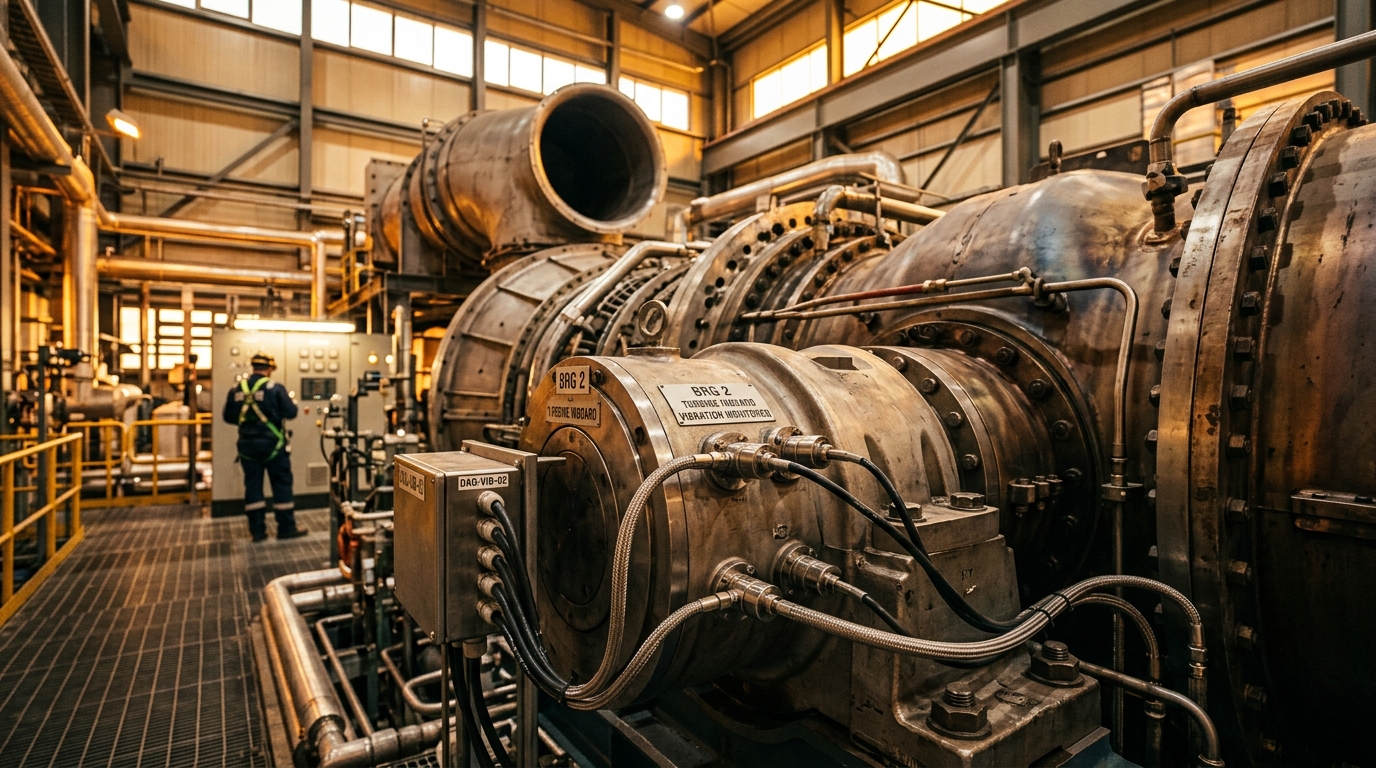
API 670 and Continuous Edge Telemetry: The Engineering Behind Turbomachinery Protection
A deep-dive analysis into eddy-current proximity probes, 2oo3 dual-voting trip circuits, and sub-millisecond edge protection architecture.
Get started
for free
Try Optruss for as long as you like with full access to autonomous agent workflows and edge telemetry. Deploy across any asset train without proprietary sensor lock-in.