
Optruss

Non-Contact Calibrated Infrared Industrial Pyrometer

Continuous non-contact optical temperature telemetry: monitoring bearing housing caps, rotating kiln shells, electrical busbars, and furnace refractories up to 600°C.

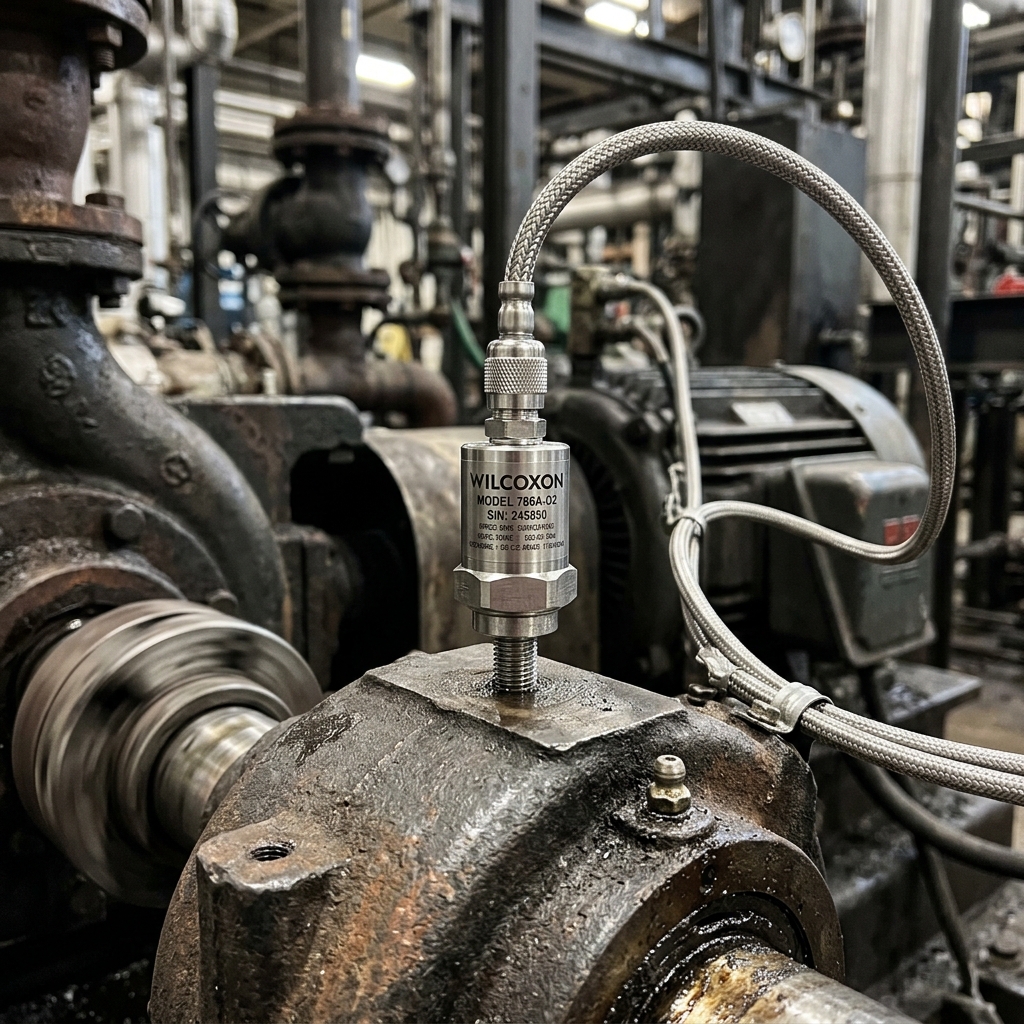
Wilcoxon 786A vibration sensor mounted on the bearing housing of a running pump

Stage 4: Severe Thermal Dissipation & Metal Softening

Captures the late-stage thermal manifestation that immediately precedes bearing seizure, winding insulation breakdown, or mechanical catastrophic jamming. Thermal telemetry validates whether high vibration is generating destructive friction heat.

Operating Principle & Signal Chain

Physical Transduction Mechanism

Operates under the Stefan-Boltzmann law of blackbody thermal radiation. Every physical object above absolute zero emits electromagnetic infrared energy. The pyrometer focuses emitted radiation between 8 and 14 µm through a precision germanium optical lens onto a calibrated thermopile detector. The thermopile converts infrared photon absorption into a microvolt potential, compensated by an internal reference junction sensor.

Electronic Signal Chain Architecture

Target Infrared Photons → Germanium Optical Bandpass Lens (8-14 µm) → Thin-Film Thermopile Detector Array → Low-Drift Chopper-Stabilized Instrumentation Amplifier → 16-bit Sigma-Delta ADC → Calibrated Polynomial Linearizer → 4-20mA DAC + RS485 Modbus.

Optical Alignment, Purge Air Collar, & Distance-to-Spot Geometry

  • Confirm optical path is completely clear of steam clouds, heavy water spray, or obstacles

  • Set target material emissivity (e.g., cast iron bearing housing = 0.93; machined steel = 0.65)

  • Connect clean instrument air purge collar to prevent dust build-up on optical lens

  • Terminate RS485 communication line with 120-ohm resistor at the furthest network node

Wiring & Shield Grounding Specifications

Calculate the target spot size using the 20:1 optical ratio (e.g., at 1,000 mm distance, the measured target circle is 50 mm in diameter). Ensure the target object completely fills this field of view. Connect dry instrument purge air (0.5 to 1.5 bar) to the vortex collar to continuously blow dust away from the germanium lens. Wire RS485 Modbus lines using 120 Ω shielded cable.

Field Commissioning Checklist

Detectable Degradation Profiles

Continuous thermal gradient tracking: dT/dt rate of rise

Sharp steep temperature rise (> 5°C per hour) crossing OEM continuous operating thermal limits (> 95°C)

Three-phase comparative temperature delta (ΔT > 15°C)

Single phase termination displaying localized heat concentration significantly hotter than adjacent phases under balanced current

External shell spatial temperature gradient scanning

Isolated outer casing hotspots indicating broken refractory bricks and localized heat breakthrough

Seal gland plate thermal telemetry monitoring

Rapid temperature spike exceeding fluid boiling point within minutes of flush fluid starvation

Hardware-Accelerated Edge Acquisition & AI Classification

Optruss Edge Telemetry correlates thermal metrics with real-time vibration and motor current. If vibration rises without a temperature rise, mechanical unbalance is flagged; if temperature rises in tandem with high-frequency acoustic emission, AssetCore raises an immediate bearing lubrication seizure emergency alarm.

Optruss Edge Sovereign Industrial Hub (Air-Gapped)

Deterministic high-speed acquisition and local AI inference: running air-gapped on DIN rails with FPGA DSP, dual isolated Ethernet, and sovereign Merkle audit ledger.

Stream Non-Contact Calibrated Infrared Industrial Pyrometer Directly to Optruss Edge

Benefit from sub-millisecond edge FFT processing, early P-F curve anomaly detection, and automated CMMS work order generation.